
|
You entered: NASA
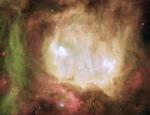 Halloween and the Ghost Head Nebula
31.10.2001
Halloween's origin is ancient and astronomical. Since the fifth century BC, Halloween has been celebrated as a cross-quarter day, a day halfway between an equinox (equal day / equal night) and a solstice (minimum day / maximum night in the northern hemisphere). With our modern calendar, however, the real cross-quarter day will occur next week.
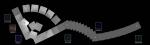 Solar System Portrait
14.02.2002
On another Valentine's Day (February 14, 1990), cruising four billion miles from the Sun, the Voyager 1 spacecraft looked back to make this first ever family portrait of our Solar System. The complete portrait is a 60 frame mosaic made from a vantage point 32 degrees above the ecliptic plane.
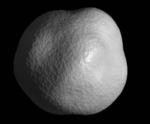 Asteroid 1998 KY26
19.09.2002
A day is just under 11 minutes long on 1998 KY26, a 30 meter wide, fast-spinning, water-rich asteroid. This computer simulated view of its lumpy surface has a resolution of about 3 meters and is based on radar and optical observations (click on the image for a series of surface views).
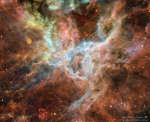 In the Heart of the Tarantula Nebula
20.05.2018
In the heart of monstrous Tarantula Nebula lies huge bubbles of energetic gas, long filaments of dark dust, and unusually massive stars. In the center of this heart, is a knot of stars so dense that it was once thought to be a single star.
 Chandra Deep Field
12.10.2002
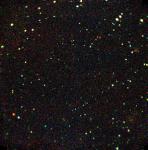
Officially the Chandra Deep Field - South, this picture represents the deepest ever x-ray image of the Universe. One million seconds of accumulated exposure time with the orbiting Chandra X-ray Observatory went in to its making.
 Composite Crab
4.09.2003
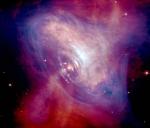
The Crab Pulsar, a city-sized, magnetized neutron star spinning 30 times a second, lies at the center of this composite image of the inner region of the well-known Crab Nebula. The spectacular picture combines...
 SN1987A s Cosmic Pearls
20.02.2004
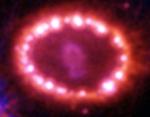
In February 1987, light from the brightest stellar explosion seen in modern times reached Earth -- supernova SN1987A. This Hubble Space Telescope image from the sharp Advanced Camera for Surveys taken in November 2003 shows the explosion site over 16 years later.
 Cassini to Venus
3.07.2004
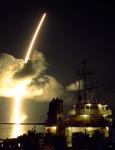
Saturn Orbiter Cassini with Titan Probe Huygens attached rocketed into early morning skies on October 15, 1997. The mighty Titan 4B Centaur rocket is seen here across the water, arcing away from Launch Complex 40 at Cape Canaveral Air Station.
 A Swift Look at Tempel 1
3.07.2005
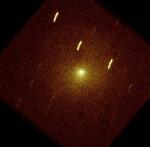
Comet Tempel 1 is targeted for a collision with the impactor probe from NASA's Deep Impact Spacecraft at about 1:52am EDT on July 4th (other time zones). Cameras on the impactor probe...
 Gibbous Europa
8.03.2009
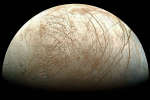
Although the phase of this moon might appear familiar, the moon itself might not. In fact, this gibbous phase shows part of Jupiter's moon Europa. The robot spacecraft Galileo captured this image mosaic during its mission orbiting Jupiter from 1995 - 2003.
|
January February March April May June July August September October |
|||||||||||||||||||||||||||||||||||||||||||||||||