
|
You entered: NASA
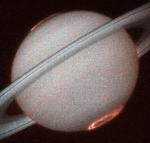 Saturnian Aurora
8.01.1998
Girdling the second largest planet in the Solar System, Saturn's Rings are one of the most spectacular sights for earthbound telescopes. This recently released image, from the orbiting Hubble Space Telescope's STIS instrument, offers a striking view of another kind of ring around Saturn - pole encircling rings of ultraviolet aurora.
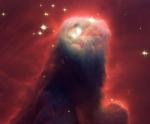 Cone Nebula Close Up
29.05.2004
Cones, pillars, and majestic flowing shapes abound in stellar nurseries where natal clouds of gas and dust are buffeted by energetic winds from newborn stars. A well-known example, the Cone Nebula within the bright galactic star-forming region NGC 2264, was captured in this close-up view from the Hubble Space Telescope's Advanced Camera for Surveys.
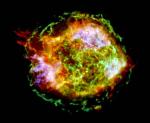 APOD: 2004 August 26- Cassiopeia A in a Million
26.08.2004
One million seconds of x-ray image data were used to construct this view of supernova remnant Cassiopeia A, the expanding debris cloud from a stellar explosion. The stunningly detailed image from the Chandra Observatory will allow an unprecedented exploration of the catastrophic fate that awaits stars much more massive than the Sun.
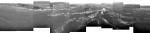 Eight Kilometers Above Titan
18.01.2005
What are these surface features on Titan? Scroll right to see the panoramic view captured last week by the Huygens probe as it descended toward Saturn's mysterious moon. Scientists are not yet sure what the above image is showing.
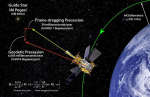 Gravity Probe B Confirms the Existence of Gravitomagnetism
10.05.2011
Does gravity have a magnetic counterpart? Spin any electric charge and you get a magnetic field. Spin any mass and, according to Einstein, you should get a very slight effect that acts something like magnetism. This effect is expected to be so small that it is beyond practical experience and ground laboratory measurement.
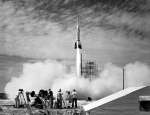 The First Rocket Launch from Cape Canaveral
18.07.2015
A new chapter in space flight began this week in 1950 July with the launch of the first rocket from Cape Canaveral, Florida: the Bumper V-2. Shown above, the Bumper V-2 was an ambitious two-stage rocket program that topped a V-2 missile base with a WAC Corporal rocket.
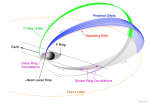 Cassinis Grand Finale Tour at Saturn
24.01.2017
Cassini is being prepared to dive into Saturn. The robotic spacecraft that has been orbiting and exploring Saturn for over a decade will end its mission in September with a spectacular atmospheric plunge. Pictured here is a diagram of Cassini's remaining orbits, each taking about one week.
 APOD: 2025 March 3 Б Blue Ghost on the Moon
2.03.2025
There's a new lander on the Moon. Yesterday Firefly Aerospace's Blue Ghost executed the first-ever successful commercial lunar landing. During its planned 60-day mission, Blue Ghost will deploy several NASA-commissioned scientific instruments, including PlanetVac which captures lunar dust after creating a small whirlwind of gas.
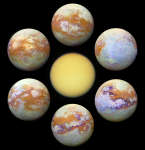 APOD: 2026 May 2 Б Seeing Titan
1.05.2026
Shrouded in a thick atmosphere, the surface of Saturn's largest moon, Titan, is really hard to see. Small particles suspended in Titan's upper atmosphere cause an almost impenetrable haze, strongly scattering light at visible wavelengths and hiding surface features from prying eyes.
 Crater On Ice
14.07.2000
Impact craters are common on Earth's moon but on Jupiter's large ice moon Europa, they are very rare. Over time, both bodies have been subjected to an intense pounding by the solar system's formative debris, but geological activity on Europa's surface seems to have erased most of these impact scars.
|
January February March April May June July August September October |
|||||||||||||||||||||||||||||||||||||||||||||||||