
|
You entered: NASA
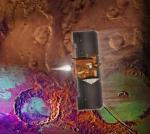 Odyssey at Mars
25.10.2001
After an interplanetary journey lasting 200 days, the Mars Odyssey spacecraft has entered orbit around the Red Planet. This latest success is welcome as in the past, Mars has often seemed a difficult planet to visit.
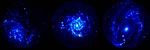 A Spiral Galaxy Gallery
9.04.1996
A progression of beautiful spiral galaxies is illustrated above with three photographs from NASA's Ultraviolet Imaging Telescope (UIT). Flying above the Earth's obscuring layer of atmosphere on the Space Shuttle Columbia during...
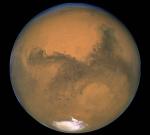 Big Mars from Hubble
27.08.2003
At about 10 am Universal Time today, Mars and Earth will pass closer than in nearly 60,000 years. Mars, noticeably red, will be the brightest object in the eastern sky just after sunset.
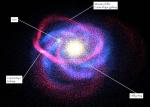 Canis Major Dwarf: A New Closest Galaxy
17.11.2003
What is the closest galaxy to the Milky Way? The new answer to this old question is the Canis Major dwarf galaxy. For many years astronomers thought the Large Magellan Cloud (LMC) was closest, but its title was supplanted in 1994 by the Sagittarius dwarf galaxy.
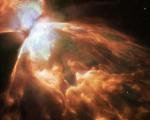 NGC 6302: Big Bright Bug Nebula
5.05.2004
The bright clusters and nebulae of planet Earth's night sky are often named for flowers or insects, and NGC 6302 is no exception. With an estimated surface temperature of about 250,000 degrees...
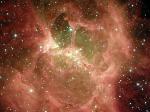 Spooky Star Forming Region DR 6
1.11.2004
How could stars form such a spooky and familiar shape as a human skull? First, the complex process of star formation creates nebulas of many shapes and sizes -- it is human perception that identifies the skull shape.
 APOD: 2023 May 2 Б Flat Rock Hills on Mars
2.05.2023
Why are there so many flat rocks on Mars? Some views of plains and hills on Mars show many rocks that are unusually flat when compared to rocks on Earth. One reason for this is a process that is common to both Mars and Earth: erosion.
 Small Moon Deimos
7.09.2024
Mars has two tiny moons, Phobos and Deimos, named for the figures in Greek mythology Fear and Panic. Detailed surface views of smaller moon Deimos are shown in both these panels. The images were taken in 2009, by the HiRISE camera on board the Mars Reconnaissance Orbiter spacecraft, NASA's long-lived interplanetary internet satellite.
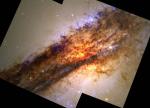 The Center of Centaurus A
1.10.2000
A fantastic jumble of young blue star clusters, gigantic glowing gas clouds, and imposing dark dust lanes surrounds the central region of the active galaxy Centaurus A. This mosaic of Hubble Space Telescope images taken in blue, green, and red light has been processed to present a natural color picture of this cosmic maelstrom.
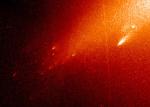 Comet LINEAR Disperses
8.08.2000
What's happened to the nucleus of Comet LINEAR? The brightest comet this year has unexpectedly broken up into many smaller pieces. The break-up occurred on or about July 25 and was noted by many astronomers around the world with particularly pioneering work by Mark Kidger (IAC).
|
January February March April May June July August September October |
|||||||||||||||||||||||||||||||||||||||||||||||||