
|
You entered: NASA
 Apollo 11: Armstrong's Lunar Selfie
22.07.2023
A photograph of Buzz Aldrin standing on the Moon taken by Neil Armstrong, was digitally reversed to create this lunar selfie. Captured in July 1969 following the Apollo 11 moon landing, Armstrong's original photograph recorded not only the magnificent desolation of an unfamiliar world, but Armstrong himself reflected in Aldrin's curved visor.
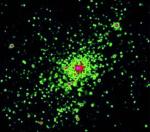 NGC 3603: X-Rays From A Starburst Cluster
24.01.2001
A mere 20,000 light-years from the Sun lies the NGC 3603 star cluster, a resident of the nearby Carina spiral arm of our Milky Way galaxy. Seen here in this recent false-color x-ray...
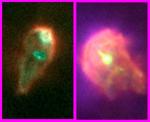 Protoplanetary Survivors in Orion
4.05.2001
The Orion Nebula is a nuturing stellar nursery filled with hot young stars and their natal clouds of gas and dust. But for planetary systems, the active star-forming region can present a hazardous and inhospitable birthplace.
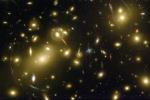 Abell 2218: A Galaxy Cluster Lens
7.10.2001
Gravity can bend light, allowing huge clusters of galaxies to act as telescopes. Almost all of the bright objects in this released Hubble Space Telescope image are galaxies in the cluster known as Abell 2218.
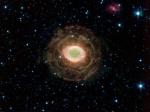 Infrared Ring Nebula
11.03.2005
The classic appearance of the popular Ring Nebula (aka M57) is understood to be due to perspective - our view from planet Earth looks down the center of a roughly barrel-shaped cloud of gas.
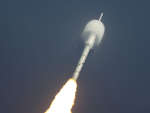 Ares 1 X Rocket Lifts Off
2.11.2009
Last week, NASA test fired a new rocket. The Ares 1-X was the first non-shuttle rocket launched from Kennedy Space Center since the Saturn launched humans to Earth orbit and the Moon in the 1960s and 1970s. NASA is testing Ares as a prelude to replacing the aging space shuttle fleet.
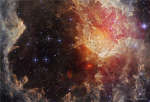 Stars and Dust Pillars in NGC 7822 from WISE
30.11.2014
Hot, young stars and cosmic pillars of gas and dust seem to crowd into NGC 7822. At the edge of a giant molecular cloud toward the northern constellation Cepheus, this glowing star forming region lies about 3,000 light-years away.
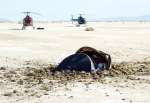 Flying Saucer Crash Lands in Utah Desert
4.11.2018
A flying saucer from outer space crash-landed in the Utah desert after being tracked by radar and chased by helicopters. The year was 2004, and no space aliens were involved. The saucer, pictured here...
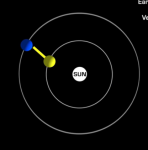 The Dance of Venus and Earth
3.06.2020
Every time Venus passes the Earth, it shows the same face. This remarkable fact has been known for only about 50 years, ever since radio telescopes have been able to peer beneath Venus' thick clouds and track its slowly rotating surface. This inferior conjunction -- when Venus and Earth are the closest -- occurs today.
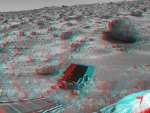 Yogi And Friends in 3D
22.08.2020
From July of 1997, a ramp from the Pathfinder lander, the Sojourner robot rover, airbags, a couch, Barnacle Bill and Yogi Rock appear together in this 3D stereo view of the surface of Mars. Barnacle Bill is the rock just left of the solar-paneled Sojourner. Yogi is the big friendly-looking boulder at top right.
|
January February March April May June July August September October |
|||||||||||||||||||||||||||||||||||||||||||||||||