
|
You entered: NASA
 Explosions Discovered Near Galactic Center
27.02.1996
Tremendous explosions near the center of our Galaxy were discovered just this past December and are being announced today by a paper in Nature and a press conference at NASA. Bursts like these have...
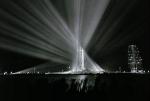 Happy Birthday Jules Verne
5.02.1998
Sunday marks the 170th anniversary of the birth of Jules Verne (born in Nantes, France on the 8th of February, 1828). Inspired by a lifelong fascination with machines, Verne wrote visionary works about "Extraordinary...
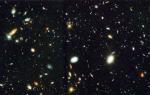 The Hubble Ultra Deep Field
8.03.2004
The above picture will be replaced later today (between 9 and 10 am EST) by the newly released Hubble Ultra Deep Field (HUDF). The HUDF is expected to be the deepest image of the universe ever taken in visible light.
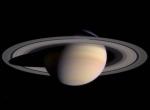 Eyeful of Saturn
30.04.2004
Now a bright speck of light wandering through Earth's night sky, magnificent planet Saturn lies nearly 1.5 billion kilometers from the Sun. But after an interplanetary voyage of seven years the planet's stunning rings nearly fill the field of the Cassini spacecraft's narrow angle camera in this image recorded on March 27.
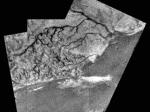 Riverbeds and Lakebeds Discovered on Saturn's Titan
23.01.2005
Methane rain, evaporating lakes, flowing rivers, and water ice-volcanoes all likely exist on Saturn's moon Titan, according to preliminary analyses of recent images taken by the successful Huygen's lander. A snaking...
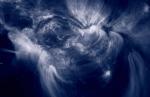 Solar Moss
26.12.1999
Discovered in recent close-up pictures of the Sun from NASA's Transition Region And Coronal Explorer (TRACE) spacecraft, this spongy-looking stuff has a temperature of 2 million degrees Fahrenheit ... and has been dubbed "Solar Moss". The false-color TRACE image above was recorded in extreme ultraviolet light on October 18.
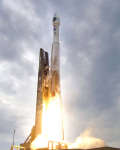 Atlas 5 Rocket Launches to the Moon
22.06.2009
This rocket is headed for the Moon. Pictured above, a huge Altas V rocket roared off the launch pad last week to start NASA's first missions to Earth's Moon in 10 years. The rocket is carrying two robotic spacecraft.
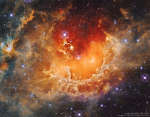 Star Formation in the Tadpole Nebula
6.05.2017
What's all of the commotion in the Tadpole nebula? Star formation. Dusty emission in the Tadpole nebula, IC 410, lies about 12,000 light-years away in the northern constellation of the Charioteer (Auriga).
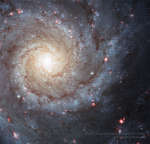 APOD: 2026 August 30 Б M74: A Grand Design Spiral
29.08.2026
If not the most grand, then this spiral galaxy is at least one of the most photogenic. An island universe of about 100 billion stars, 32 million light-years away toward the constellation Pisces, M74 presents a gorgeous face-on view.
 N81: Star Cradle in the SMC
5.10.2000
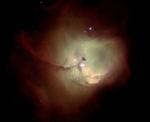
This dramatic Hubble Space Telescope image captures the birth of a cluster of massive stars. The newborn stars are seen just as they emerge from their natal nebula. Only 12 light-years across, the nebula...
|
January February March April May June July August September October |
|||||||||||||||||||||||||||||||||||||||||||||||||