
|
You entered: NASA
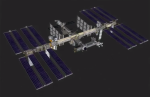 Assembly of The International Space Station
9.11.2015
It is the largest and most sophisticated object ever built off the Earth. It has taken numerous spaceflights and over a decade to construct. The International Space Station (ISS) is currently the premiere habitat...
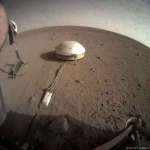 SEIS: Listening for Marsquakes
4.06.2019
If you put your ear to Mars, what would you hear? To find out, and to explore the unknown interior of Mars, NASA's Insight Lander deployed SEIS late last year, a sensitive seismometer that can detect marsquakes.
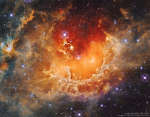 Star Formation in the Tadpole Nebula
28.01.2020
What's all of the commotion in the Tadpole Nebula? Star formation. Dusty emission in the Tadpole Nebula, IC 410, lies about 12,000 light-years away in the northern constellation of the Charioteer (Auriga).
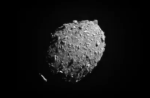 DART: Impact on Asteroid Dimorphos
27.09.2022
Could humanity deflect an asteroid headed for Earth? Yes. Deadly impacts from large asteroids have happened before in Earth's past, sometimes causing mass extinctions of life. To help protect our Earth from some...
 APOD: 2025 April 20 Б The Orion Nebula in Visible and Infrared
20.04.2025
The Great Nebula in Orion is a colorful place. Visible to the unaided eye, it appears as a small fuzzy patch in the constellation of Orion. Long exposure, multi-wavelength images like this, however, show the Orion Nebula to be a busy neighborhood of young stars, hot gas, and dark dust.
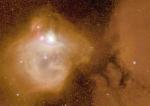 New Stars Destroying NGC 1748
3.04.2001
NGC 1748 cannot contain all the new stars it has formed. The young stars, the most massive of which are bright blue, emit so much energy they are pushing out and dispersing the gas and dust that comprise this star forming nebula.
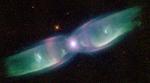 M2 9: Wings of a Butterfly Nebula
17.12.2000
Are stars better appreciated for their art after they die? Actually, stars usually create their most artistic displays as they die. In the case of low-mass stars like our Sun and M2-9 pictured above
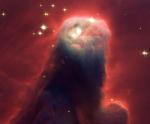 Cone Nebula Close Up
3.05.2002
Cones, pillars, and majestic flowing shapes abound in stellar nurseries where natal clouds of gas and dust are buffeted by energetic winds from newborn stars. A well-known example, the Cone Nebula within the bright galactic star-forming region NGC 2264, was captured in this close-up view from the Hubble Space Telescope's newest camera.
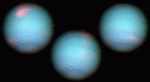 The Clouds of Neptune
7.05.1996
These Hubble Space Telescope (HST) images reveal glimpses of the dynamic atmosphere of Neptune, the Solar System's most distant gas giant planet. The first close-up of Neptune's clouds was provided by NASA's Voyager 2 spacecraft during its August 1989 flyby, giving a tantalizingly brief look.
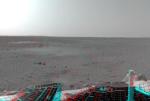 Spirit s 3D View Towards Sleep Hollow
6.01.2004
Working late, tired mission members nicknamed the smooth-looking depression to the left of center in this image from the martian surface, Sleepy Hollow. The picture is a portion of the 3D panorama of the Spirit rover's landing site released yesterday, constructed with data from the Mars rover's navigation cameras.
|
January February March April May June July August September October |
|||||||||||||||||||||||||||||||||||||||||||||||||