
|
You entered: NASA
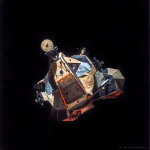 Apollo 17 s Moonship
26.12.2025
Awkward and angular looking, Apollo 17's lunar module Challenger was designed for flight in the near vacuum of space. Digitally enhanced and reprocessed, this picture taken from Apollo 17's command module America shows Challenger's ascent stage in lunar orbit.
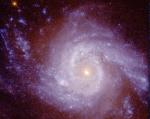 Spiral Galaxy NGC 3310 in Ultraviolet
16.01.2001
Why is NGC 3310 bursting with young stars? The brightest of these new stars are so hot that they light up this spiral galaxy not only in blue light, but in light so blue humans can't see it: ultraviolet. The Hubble Space Telescope took the above photograph in different bands of ultraviolet light.
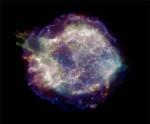 Cas A Supernova Remnant in X Rays
24.08.2002
The complex shell of a star seen to explode 300 years ago is helping astronomers to understand how that star exploded. This Chandra Observatory image of supernova remnant Cassiopeia A (Cas A) shows unprecedented detail in three x-ray colors.
 Gamma Ray Bursts from the Unknown
22.11.1996
Gamma Ray Bursts (GRBs) pose one of the greatest mysteries of modern astronomy. About once a day, the gamma-ray sky lights up with a spectacular explosion. No one knows what causes these explosions or even how far away they are.
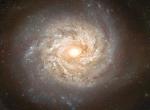 Spiral Galaxy NGC 3982 Before Supernova
2.11.2003
What do stars look like just before they explode? To find out, astronomers are taking detailed images of nearby galaxies now, before any supernova is visible. Hopefully, a star in one of the hundreds of high resolution galaxy images will explode in the coming years.
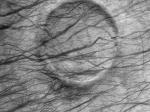 A Dust Devil Crater on Mars
29.12.2003
What caused the streaks in this Martian crater? Since the above image shows streaks occurring both inside and outside the crater, they were surely created after the crater-causing impact. Newly formed trails like these...
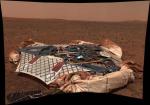 Columbia Memorial Station
21.01.2004
After leaving its nest, the Spirit rover turned to captured this spectacular view over the Colombia Memorial Station and the floor of Gusev crater on the 16th sol of its visit to Mars. The sharp picture looks toward the northeast.
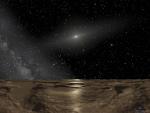 Sedna at Noon
4.06.2004
Standing on Sedna - the solar system's most distant known planetoid - your view of the Sun at high noon might look something like this. An artist's dramatic vision, the picture shows the Sun suspended above the nearby horizon as a bright star immersed in the dusty ecliptic plane.
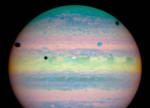 Pastel Planet, Triple Eclipse
10.11.2004
This false-color image of banded gas giant Jupiter shows a triple eclipse in progress on March 28 - a relatively rare event, even for a large planet with many moons. Captured by the Hubble Space...
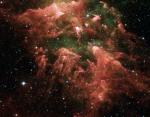 Sculpting the South Pillar
2.06.2005
Eta Carinae, one of the most massive and unstable stars in the Milky Way Galaxy, has a profound affect on its environment. Found in the the South Pillar region of the Carina Nebula, these...
|
January February March April May June July August September October |
|||||||||||||||||||||||||||||||||||||||||||||||||