
|
You entered: NASA
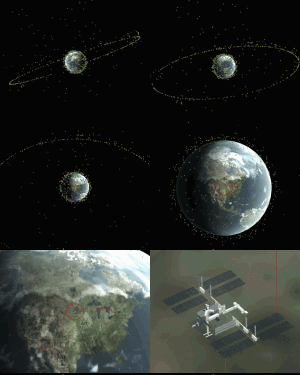 The Satellites that Surround Earth
14.07.2003
Thousands of satellites orbit the Earth. Costing billions of dollars, this swarm of high altitude robots is now vital to communication, orientation, and imaging both Earth and space. One common type of orbit is geostationary where a satellite will appear to hover above one point on Earth's equator.
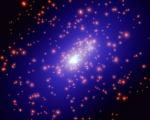 Dark Matter Map
14.08.2003
The total mass within giant galaxy cluster CL0025+1654, about 4.5 billion light-years away, produces a cosmic gravitational lens -- bending light as predicted by Einstein's theory of gravity and forming detectable images of even more distant background galaxies.
 Arp 81: 100 Million Years Later
11.12.2003
From planet Earth, we view this strongly interacting pair of galaxies, cataloged as Arp 81, as they were only about 100 million years after their mutual closest approach. The havoc wreaked by gravity during...
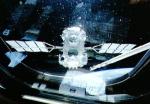 Compton Observatory In Orbit
8.04.2000
Nine years ago the massive Compton Gamma Ray Observatory was deployed in low earth orbit. Sparkling interior reflections and the bright limb of the Earth are visible in this 1991 window view of Compton's release by the crew of the Space Shuttle Atlantis.
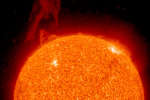 A Solar Prominence Erupts in STEREO
20.10.2009
What does a solar prominence look like in three dimensions? To help find out, NASA launched the STEREO satellites to keep a steady eye on the Sun from two different vantage points. The STEREO...
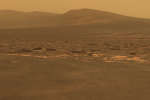 Rover Arrives at Endeavor Crater on Mars
15.08.2011
What can the present-day terrain in and around large Endeavor crater tell us about ancient Mars? Starting three years ago, NASA sent a coffee-table sized robot named Opportunity on a mission rolling across the red planet's Meridiani Planum to find out. Last week, it finally arrived.
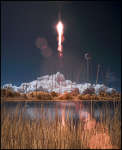 Antares Rocket Launch
21.09.2013
The sky looks dark in this scene from the Mid-Atlantic Regional Spaceport (MARS) at NASA Wallops Flight Facility, Virginia. Captured on Wednesday, September 18, an Orbital Sciences Corporation Antares rocket is leaving launch pad-0A with the Cygnus cargo spacecraft aboard.
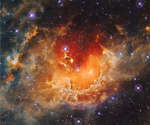 Star Formation in the Tadpole Nebula
17.11.2014
Dusty emission in the Tadpole nebula, IC 410, lies about 12,000 light-years away in the northern constellation Auriga. The cloud of glowing gas is over 100 light-years across, sculpted by stellar winds and radiation from embedded open star cluster NGC 1893.
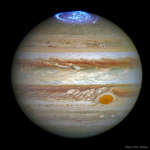 Aurorae on Jupiter
11.07.2016
Jupiter has aurorae. Like Earth, the magnetic field of the gas giant funnels charged particles released from the Sun onto the poles. As these particles strike the atmosphere, electrons are temporarily knocked away from existing gas molecules. Electric force attracts these electrons back. As the electrons recombine to remake neutral molecules, auroral light is emitted.
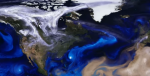 Hurricane Season Animated
27.11.2017
Where do hurricanes go? To better understand dangerous storms, NASA compiled data from several satellites into a supercomputer simulation of this past year's hurricane season. Specifically, the featured video shows how smoke (white), sea salt (blue), and dust (brown) tracked from 2017 August through October across the northern half of Earth's Western Hemisphere.
|
January February March April May June July August September October |
|||||||||||||||||||||||||||||||||||||||||||||||||