
|
You entered: NASA
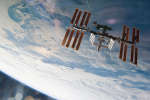 The International Space Station from Above
3.03.2010
The International Space Station (ISS) is the largest human-made object ever to orbit the Earth. The ISS is so large that it can be seen drifting overhead with the unaided eye, and is frequently imaged from the ground in picturesque fashion.
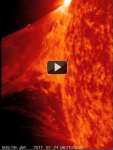 A Solar Prominence Eruption from SDO
7.03.2011
One of the most spectacular solar sights is an erupting prominence. Two weeks ago, NASA's Sun-orbiting Solar Dynamic Observatory spacecraft imaged an impressively large prominence erupting from the surface. The dramatic explosion...
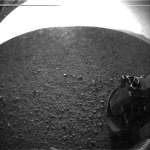 A Wheel on Mars
7.08.2012
A wheel attached to NASA's Curiosity rover is firmly on the martian surface in this early picture from the Mars Science Laboratory mission, captured after a successful landing on August 5, 2012 at 10:32pm (PDT).
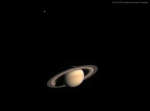 Cassini Approaches Saturn
10.04.2016
Cassini, a robot spacecraft launched in 1997 by NASA, became close enough in 2002 to resolve many rings and moons of its destination planet: Saturn. At that time, Cassini snapped several images during an engineering test. Several of those images were combined into the contrast-enhanced color composite featured here.
 The Cartwheel Galaxy from Hubble
18.12.2016
To some, it looks like the wheel of a cart. In fact, because of its outward oval appearance, the presence of a central galaxy, and their connection with what looks like the spokes of a wheel, the galaxy on the right is known as the Cartwheel Galaxy.
 Ares 3 Landing Site: The Martian Revisited
17.05.2025
This close-up from the Mars Reconnaissance Orbiter's HiRISE camera shows weathered craters and windblown deposits in southern Acidalia Planitia. A striking shade of blue in standard HiRISE image colors, to the human eye the area would probably look grey or a little reddish.
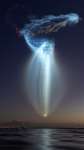 APOD: 2026 March 19 Б Launch Plume: SpaceX Jellyfish
19.03.2026
Even if you live with your head in the clouds, you wonБt find a jellyfish like this one very often. The featured image shows a SpaceX Falcon 9 rocket launch from Cape Canaveral in Florida on March 4.
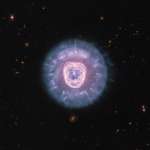 APOD: 2026 August 26 Б JWST Images The Lion's Head Nebula
26.08.2026
Are we looking at the future of our Sun? The James Webb Space Telescope captured todayБs composite image of the LionБs Head Nebula (NGC 2392) with its NIRCam and MIRI instruments. The LionБs Head Nebula is the remnant of a Sun-like star.
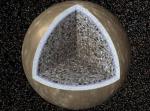 Cutaway Callisto: Ice, Rock, and Ocean
6.11.1998
Cruising past the moons of reigning gas giant Jupiter, Voyager and Galileo have returned tantalizing evidence for a liquid water ocean beneath the surface of Europa. Now researchers are reporting telltale indications that the battered Jovian moon Callisto may also harbor a subsurface
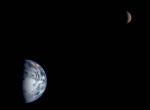 The Earth-Moon System
29.01.1998
This evocative mosaic image of the Earth-Moon system was recorded by NASA's Near Earth Asteroid Rendezvous (NEAR) spacecraft earlier this month. The relative sizes shown are appropriate for viewing both the Earth...
|
January February March April May June July August September October |
|||||||||||||||||||||||||||||||||||||||||||||||||