
|
You entered: NASA
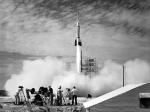 The First Rocket Launch from Cape Canaveral
4.06.2006
A new chapter in space flight began on 1950 July with the launch of the first rocket from Cape Canaveral, Florida: the Bumper 2. Shown above, the Bumper 2 was an ambitious two-stage rocket program that topped a V-2 missile base with a WAC Corporal rocket.
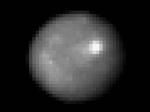 Ceres: Asteroid or Planet
21.08.2006
Is Ceres an asteroid or a planet? Although a trivial designation to some, the recent suggestion by the Planet Definition Committee of the International Astronomical Union would have Ceres reclassified from asteroid to planet. A change in taxonomy might lead to more notoriety for the frequently overlooked world.
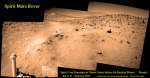 The Last Panorama of the Spirit Rover on Mars
30.05.2011
This is the last thing that the Spirit rover on Mars ever saw. Operating years beyond original expectations, Spirit eventually got mired in martian dirt and then ran out of power when investigating the unusual Home Plate surface feature on Mars.
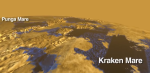 Soaring over Titan
23.11.2014
What would it look like to fly over Titan? Radar images from NASA's robotic Cassini satellite in orbit around Saturn have been digitally compiled to simulate such a flight. Cassini has swooped past Saturn's cloudiest moon several times since it arrived at the ringed planet in 2004.
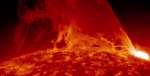 A Solar Prominence Eruption from SDO
6.03.2016
One of the most spectacular solar sights is an erupting prominence. In 2011, NASA's Sun-orbiting Solar Dynamic Observatory spacecraft imaged an impressively large prominence erupting from the surface. The dramatic explosion was captured in ultraviolet light in the above time lapse video covering 90 minutes, where a new frame was taken every 24 seconds.
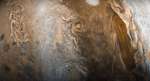 Orbiting Jupiter
7.06.2017
What would it be like to orbit Jupiter? The dramatic featured video depicts just this and was made from images taken by NASA's Juno spacecraft currently orbiting the Jovian giant. Juno recently completed its sixth pass near Jupiter during its looping elliptical six-week orbit.
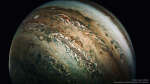 Enhanced: The Dolphin Cloud on Jupiter
15.04.2019
Do you see the dolphin-shaped cloud on Jupiter? The cloud was visible last year during perijove 16, the sixteenth time that NASA's robotic spacecraft Juno passed near Jupiter since it arrived in mid-2016. During each perijove, Juno passes near a slightly different part of Jupiter's cloud tops.
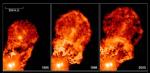 XZ Tauri System Ejects Gas Bubble
21.09.2000
Why is the binary star system XZ Tauri emitting a hot bubble of expanding gas? Although astronomers can only presently speculate, the Hubble Space Telescope clearly documents this unusual behavior in three dramatic photographs over the past five years.
 Emerging Planetary Nebula CRL 618
6.09.2000
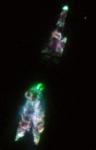
CRL 618 may look to some like an Olympian declaring victory. Only a few hundred years ago, however, CRL 618 appeared as a relatively modest red giant star. Since then it has run out of core material to fuse and so has started to become a planetary nebula.
 In the Heart of the Crab
5.06.2000
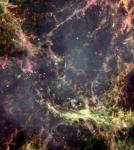
The supernova explosion that formed the Crab Nebula was first seen on the year 1054. Last week, astronomers released a new image of the still-evolving center of the explosion. The above representative-color photograph...
|
January February March April May June July August September October |
|||||||||||||||||||||||||||||||||||||||||||||||||