
|
You entered: NASA
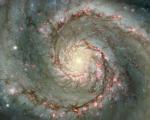 M51: The Whirlpool Galaxy in Dust and Stars
10.04.2001
The Whirlpool Galaxy is a classic spiral galaxy. At only 30 million light years distant and fully 60 thousand light years across, M51, also known as NGC 5194, is one of the brightest and most picturesque galaxies on the sky.
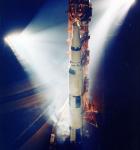 Saturn The Giant
25.05.2001
Forty years ago today (May 25, 1961) U.S. president John Kennedy announced the goal of landing Americans on the Moon by the end of the decade. Kennedy's ambitious speech triggered a nearly unprecedented peacetime technological mobilization and one result was the Saturn V moon rocket.
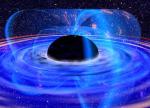 Spinning Black Holes and MCG 6 30 15
29.10.2001
What makes the core of galaxy MCG-6-30-15 so bright? Some astronomers believe the answer is a massive spinning black hole. If so, this would be the first observational indication that it is possible to make a black hole act like a battery -- and tap into its rotational energy.
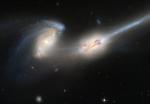 NGC 4676: When Mice Collide
12.06.2004
These two mighty galaxies are pulling each other apart. Known as "The Mice" because they have such long tails, each spiral galaxy has likely already passed through the other. They will probably collide again and again until they coalesce.
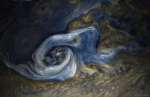 Juno Spots a Complex Storm on Jupiter
28.11.2017
Some storms on Jupiter are quite complex. The swirling storm was captured late last month by the NASA's robotic Juno spacecraft currently orbiting the Solar System's largest planet. The featured image spans about 30,000 kilometers, making this storm system just about as wide as planet Earth.
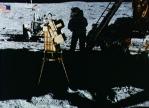 The First Lunar Observatory
11.11.2000
The first, and so far only, lunar astronomical observatory was deployed by the Apollo 16 crew in 1972. The Far Ultraviolet Camera / Spectrograph used a 3-inch diameter Schmidt telescope to photograph the Earth, nebulae, star clusters, and the Large Magellanic Cloud.
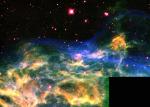 At the Edge of the Crescent Nebula
2.08.2000
The Crescent Nebula is a rapidly expanding shell of gas surrounding a dying star. In this recently released image by the Hubble Space Telescope, a bright dynamic part of the nebula three light-years across is shown in representative color.
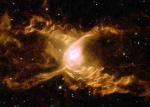 The Red Spider Planetary Nebula
24.07.2001
Oh what a tangled web a planetary nebula can weave. The Red Spider Planetary Nebula shows the complex structure that can result when a normal star ejects its outer gases and becomes a white dwarf star.
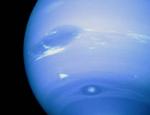 Dark Spots on Neptune
21.08.2001
Neptune has spots. The Solar System's outermost gas giant shows a nearly uniform blue hue created by small amounts of methane drifting in a thick atmosphere of nearly colorless hydrogen and helium. Dark spots do appear, however, that are anti-cyclones: large high-pressure systems that swirl in Neptune's cold cloud tops.
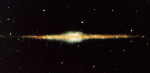 The Milky Way's Center
8.09.1995
NASA's COBE satellite scanned the heavens at infrared wavelengths in 1990 and produced this premier view of the central region of our own Milky Way Galaxy. The Milky Way is a typical spiral galaxy with a central bulge and extended disk of stars.
|
January February March April May June July August September October |
|||||||||||||||||||||||||||||||||||||||||||||||||