
|
You entered: NASA
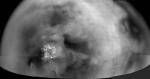 Titan Through the Haze
26.10.2004
What are these surface features on Titan? This planet-sized moon of Saturn had much of its south polar surface imaged during an initial flyby by the Saturn-orbiting Cassini spacecraft back in early July.
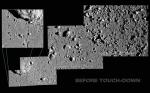 NEAR at Eros: Before Touchdown
12.02.2005
On 12 February, 2001, the NEAR-Shoemaker spacecraft gently touched-down on the the surface of Eros -- the first ever landing on an asteroid. During the descent, the spacecraft's camera recorded successive images of the diminutive world's surface, revealing fractured boulders, dust filled craters, and a mysterious collapsed channel.
 A Solar Ballet
15.01.2013
Sometimes, the Sun itself seems to dance. On just this past New Year's Eve, for example, NASA's Sun-orbiting Solar Dynamic Observatory spacecraft imaged an impressive prominence erupting from the Sun's surface. The dramatic explosion was captured in ultraviolet light in the above time lapse video covering four hours.
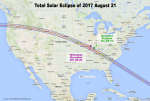 Map of Total Solar Eclipse Path in 2017 August
21.08.2016
Would you like to see a total eclipse of the Sun? If so, do any friends or relatives live near the path of next summer's eclipse? If yes again, then you might want to arrange a visit for one year from today.
 Earths San Andreas Fault
7.12.2000
The Earth's surface is broken. Cracks in the Earth's crust known as faults can run for hundreds of kilometers. These faults are frequently the sites of major earthquakes as the tectonic plates that cover the surface of the Earth shift.
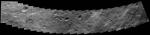 Close To Eros
27.10.2000
Scroll right and fly close over asteroid Eros! This long mosaic was constructed of images returned yesterday by the NEAR Shoemaker spacecraft as it orbited to within 6.4 kilometers of a spot in the southern hemisphere of the rotating asteroid's surface.
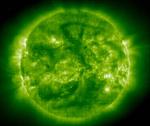 S is for Sun
21.03.2002
Taken yesterday from the SOHO spacecraft, this false-color image shows the active Sun near the March Equinox, the beginning of Fall in the south and Spring in the northern hemisphere. Recorded in a band...
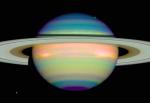 Infrared Saturn
22.02.2003
This delightfully detailed false-color image of Saturn was taken in January 1998 by the orbiting Hubble Space Telescope. The picture is a combination of three images from Hubble's NICMOS instrument and shows the lovely ringed planet in reflected infrared sunlight.
 An Apollo 15 Panorama
13.01.2004
The Apollo 15 mission to Earth's Moon was dedicated to better understanding the surface of the moon by exploring mountains, valleys, maria, and highlands. Astronauts David Scott and James Irwin spent nearly three days on the Moon while Alfred Worden orbited above in the Command Module.
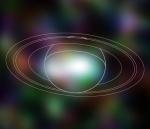 X Ray Saturn
12.03.2004
Above, the ringed planet Saturn shines in x-rays. Otherwise beyond the range of human vision, the eerie x-ray view was created by overlaying a computer generated outline of the gas giant's disk and ring system on a false-color picture of smoothed, reconstructed x-ray data from the orbiting Chandra Observatory.
|
January February March April May June July August September October |
|||||||||||||||||||||||||||||||||||||||||||||||||