
|
You entered: NASA
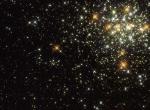 NGC 1818: A Young Globular Cluster
11.03.2001
Globular clusters once ruled the Milky Way. Back in the old days, back when our Galaxy first formed, perhaps thousands of globular clusters roamed our Galaxy. Today, there are perhaps 200 left. Many globular clusters were destroyed over the eons by repeated fateful encounters with each other or the Galactic center.
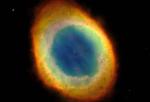 M57: The Ring Nebula
16.07.2000
Except for the rings of Saturn, The Ring Nebula (M57) is probably the most famous celestial band. This planetary nebula's simple, graceful appearance is thought to be due to perspective -- our view from planet Earth looking straight into what is actually a barrel-shaped cloud of gas shrugged off by a dying central star.
 A Martian Metamorphosis
4.06.2002
Is it an Escher, or Mars? Three different types of surfaces visible in the North Polar Cap of Mars morph into each other in a way perhaps reminiscent of the works of M. C. Escher. On the far left dark sand covers the ground, while the center shows a transition to a dune field.
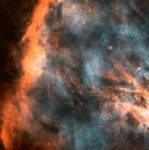 The Great Nebula in Orion
3.07.1995
The Great Nebula in Orion, M42, can be found on the night sky just below and to the left of the easily identifiable belt of three stars in the popular constellation Orion. This nebula is one of the closest stellar nurseries - where young stars are being formed even now.
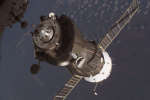 A Supply Ship Docks with the International Space Station
14.05.2008
Looking out a window of the International Space Station brings breathtaking views. Visible vistas include a vast and colorful Earth, a deep dark sky, and an occasional spaceship sent to visit the station. Visible early last month was a Soyuz TMA-12 spacecraft carrying not only supplies but also three newcomers.
 APOD: 2024 July 28 Б Sun Dance
28.07.2024
Sometimes, the surface of our Sun seems to dance. In the middle of 2012, for example, NASA's Sun-orbiting Solar Dynamic Observatory spacecraft imaged an impressive prominence that seemed to perform a running dive roll like an acrobatic dancer.
 APOD: 2024 November 17 Б LDN 1471: A Windblown Star Cavity
17.11.2024
What is the cause of this unusual parabolic structure? This illuminated cavity, known as LDN 1471, was created by a newly forming star, seen as the bright source at the peak of the parabola.
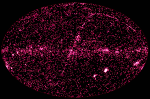 Exploring The Universe With IUE (1978-1996)
30.09.1996
How do planets, stars, and galaxies form? How do they evolve? The International Ultraviolet Explorer (IUE) satellite was launched in 1978 and operated by NASA/ ESA/ PPARC to help provide answers to some of the most fundamental questions about the contents of our universe.
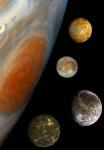 Jupiter And Family
18.11.2000
This composite image features classic portraits of members of one of the Solar System's most prominent families - Jupiter and its four large "Galilean" moons. Starting from the top the moons are Io, Europa, Ganymede, and Callisto. The top-to-bottom order is also the order of increasing distance from Jupiter.
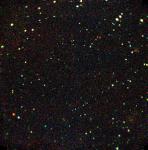 Chandra Deep Field
28.03.2001
Officially the Chandra Deep Field - South, this picture represents the deepest ever x-ray image of the Universe. One million seconds of accumulated exposure time with the orbiting Chandra X-ray Observatory went in to its making.
|
January February March April May June July August September October |
|||||||||||||||||||||||||||||||||||||||||||||||||