
|
You entered: NASA
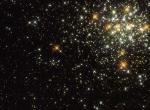 NGC 1818: A Young Globular Cluster
29.12.2002
Globular clusters once ruled the Milky Way. Back in the old days, back when our Galaxy first formed, perhaps thousands of globular clusters roamed our Galaxy. Today, there are perhaps 200 left. Many globular clusters were destroyed over the eons by repeated fateful encounters with each other or the Galactic center.
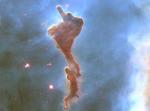 Disappearing Clouds in Carina
30.06.2003
This dense cloud of gas and dust is being deleted. Likely, within a few million years, the intense light from bright stars will have boiled it away completely. Stars not yet formed in the molecular cloud's interior will then stop growing.
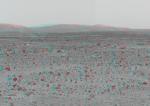 The Hills of Mars
8.01.2004
Distant hills rise above a rocky, windswept plain in this sharp stereo scene from the Spirit rover on Mars. When viewed with red/blue glasses, the picture combines left and right images from Spirit's high resolution panoramic camera to yield a dramatic 3D perspective.
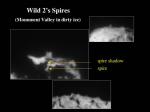 Unusual Spires Found on Comet Wild 2
22.06.2004
How did unusual spires form on comet Wild 2? Close inspection of images taken of Comet Wild 2 by the passing Stardust spacecraft in January show numerous strange pinnacles as long as 100 meters long jutting off the surface. The pinnacles were unexpected - close-ups of other comets and asteroids show no such features.
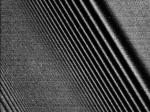 Cassini Images Density Waves in Saturns Rings
5.07.2004
What causes the patterns in Saturn's rings? The Cassini spacecraft just entering orbit around Saturn has started sending back spectacular images of Saturn's immense ring system in unprecedented detail. The physical cause for many of newly resolved ring structures is not always understood.
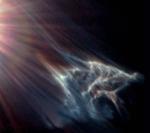 Reflecting Merope
4.12.2004
In the well known Pleiades star cluster, a star's light is slowly destroying this wandering cloud of gas and dust. Above, the star Merope lies just off the upper left edge of this picture from the Hubble Space Telescope.
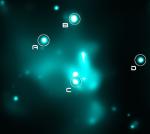 The Swarm
28.01.2005
What do you call a group of black holes ... a flock, a brace, a swarm? Monitoring a region around the center of our Galaxy, astronomers have indeed found evidence for a surprisingly large number...
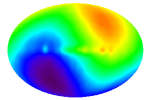 CMB Dipole: Speeding Through the Universe
15.06.2014
Our Earth is not at rest. The Earth moves around the Sun. The Sun orbits the center of the Milky Way Galaxy. The Milky Way Galaxy orbits in the Local Group of Galaxies. The Local Group falls toward the Virgo Cluster of Galaxies.
 APOD: 2024 December 31 Б The Twisted Disk of NGC 4753
31.12.2024
What do you think this is? HereБs a clue: it's bigger than a bread box. Much bigger. The answer is that pictured NGC 4753 is a twisted disk galaxy, where unusual dark dust filaments provide clues about its history.
 APOD: 2025 January 20 Б Comet ATLAS Rounds the Sun
20.01.2025
Why does Comet ATLAS have such colorful tails? Last week Comet C/2024 G3 (ATLAS) passed its closest to the Sun -- well inside the orbit of Mercury -- and brightened dramatically. Unfortunately, the comet was then so angularly near the Sun that it was very hard for humans to see. But NASA's SOHO spacecraft saw it.
|
January February March April May June July August September October |
|||||||||||||||||||||||||||||||||||||||||||||||||