
|
You entered: NASA
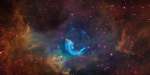 Approaching the Bubble Nebula
31.05.2017
What would it look like to approach the Bubble Nebula? Blown by the wind and radiation from a massive star, this bubble now spans seven light-years in diameter. The hot star inside is thousands of times more luminous than our Sun, and is now offset from the nebula's center.
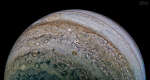 Complex Jupiter
5.06.2018
How complex is Jupiter? NASA's Juno mission to Jupiter is finding the Jovian giant to be more complicated than expected. Jupiter's magnetic field has been discovered to be much different from our Earth's simple dipole field, showing several poles embedded in a complicated network more convoluted in the north than the south.
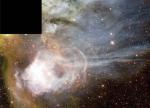 N44C: A Nebular Mystery
14.05.2002
Why is N44C glowing so strangely? The star that appears to powers the nebula, although young and bright, does not seem hot enough to create some of the colors observed. A search for a hidden hotter star in X-rays has come up empty.
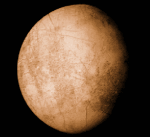 Europa: Oceans of Life?
6.08.1996
Is there life beneath Europa's frozen surface? Some believe the oceans found there of carbon-enriched water are the best chance for life, outside the Earth, in our Solar System. Europa, the fourth largest moon of Jupiter, was recently discovered to have a thin oxygen atmosphere by scientists using the Hubble Space Telescope.
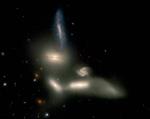 Seyfert's Sextet
24.01.2003
Known as Seyfert's Sextet, this intriguing group of galaxies lies in the head portion of the split constellation Serpens. The sextet actually contains only four interacting galaxies, though. Near the center of this...
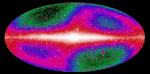 Stars in the Infrared Sky
18.09.1996
What if you could see infrared light? Because this light is less absorbed by dust than visible light, you could peer into the center of our Milky Way Galaxy. The stars there are normally hidden from direct view by the interstellar dust clouds which line the Galactic plane.
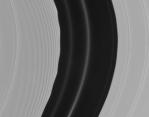 The Encke Gap: A Moon Goes Here
2.07.2004
Yesterday, Cassini became the first spacecraft to enter orbit around the gas giant Saturn, rocketing through a 25,000 kilometer wide gap in the distant planet's magnificent system of icy rings at about 15 kilometers per second.
 M51: Cosmic Whirlpool
28.04.2005
Follow the handle of the Big Dipper away from the dipper's bowl, until you get to the handle's last bright star. Then, just slide your telescope a little south and west and you might find this stunning pair of interacting galaxies, the 51st entry in Charles Messier's famous catalog.
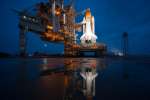 Atlantis Reflection
9.07.2011
Space shuttle orbiter Atlantis left planet Earth on Friday, July 8, embarking on the STS-135 mission to the International Space Station. The momentous launch was the final one in NASA's 30 year space shuttle program that began with the launch of the first reusable spacecraft on April 12, 1981.
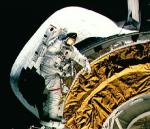 Space Walz
26.09.1998
Astronaut Carl Walz waves at his colleagues from the aft end of the Space Shuttle Discovery's payload bay. During this 1993 spacewalk, Walz evaluated tools, tethers, and a foot restraint designed for use in a weightless environment while orbiting Planet Earth.
|
January February March April May June July August September October |
|||||||||||||||||||||||||||||||||||||||||||||||||