
|
You entered: NASA
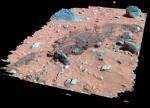 Martian Surface in Perspective
16.01.2004
Spirit moved across Mars yesterday as the rover successfully maneuvered down off its lander, driving its six wheels onto the floor of Gusev crater. As planned, the robotic geologist will now begin a close-up examination of the rocks and soil around the landing site for clues to the processes that formed them.
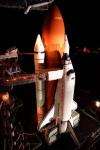 John Glenn: Discovery Launch
30.10.1998
At left, the Space Shuttle Discovery waits in darkness on Kennedy Space Center's launch pad 39B. At right, on Thursday October 29, Discovery blasts through a bright afternoon sky returning Senator John Glenn to space over 36 years after he became the first American in orbit.
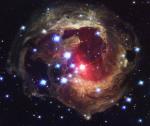 V838 Mon: Light Echo Update
4.02.2005
Expanding light echoes continue to illuminate the dusty environs of V838 Monocerotis, mysterious variable star near the edge of our Galaxy. This stunning image, produced from Hubble data recorded in October of 2004, adds to a unique series of space-based, high-resolution views.
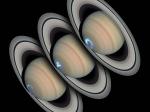 Persistent Saturnian Auroras
22.02.2005
Are Saturn's auroras like Earth's? To help answer this question, the Hubble Space Telescope and the Cassini spacecraft monitored Saturn's South Pole simultaneously as Cassini closed in on the gas giant in January 2004. Hubble snapped images in ultraviolet light, while Cassini recorded radio emissions and monitored the solar wind.
 Saturnian Moon and Rings
18.04.2005
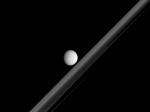
When can a robot produce art? When it glides past the rings of Saturn, for one. As the robot spacecraft Cassini orbiting Saturn crossed outside the famous photogenic ring plane of the expansive planet, the rings were imaged from the outside, nearly edge on, and in the shadow of Saturn.
 NGC 3314: When Galaxies Overlap
7.05.2005
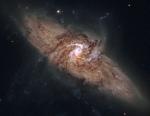
NGC 3314 consists of two large spiral galaxies which just happen to almost exactly line-up. The foreground spiral is viewed nearly face-on, its pinwheel shape defined by young bright star clusters. But against the glow of the background galaxy, dark swirling lanes of interstellar dust are also seen to echo the face-on spiral's structure.
 APOD: 2026 September 5 Б Chasing the Moon s Shadow
5.09.2026
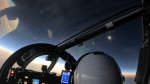
Chasing the shadow of a New Moon, NASAБs WB-57F high altitude research aircraft took to the skies off the coast of Iceland on August 12 to observe a total solar eclipse. At 50,000 feet the aircraft was piloted along the precisely determined path of totality to maximize its time in the MoonБs shadow.
 The Yardangs Of Mars
14.11.2000
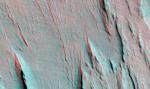
OK, fans of classic science fiction might be disappointed. The yardangs are not barsoomian warriors in a newly discovered Edgar Rice Burroughs tale of adventure and conquest on the Red Planet. In fact yardangs, geologists' term for narrow, wind-eroded ridges, are common land features in the desert regions of planet Earth.
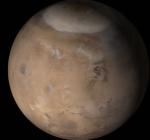 Springtime on Mars
22.04.2003
Vast canyons, towering volcanoes, sprawling fields of ice, deep craters, and high clouds can all be seen in this image of the Solar System's fourth planet: Mars. The orbiting robot Mars Global Surveyor spacecraft took the above mosaic of images as springtime dawned in Northern Mars in 2002 May.
 A Primodrial Quasar
20.05.2003
What did the first quasars look like? The nearest quasars are now known to be supermassive black holes in the centers of galaxies. Gas and dust that falls toward a quasar glows brightly, sometimes outglowing the entire home galaxy.
|
January February March April May June July August September October |
|||||||||||||||||||||||||||||||||||||||||||||||||