
|
You entered: NASA
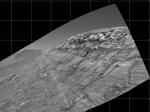 Burns Cliff on Mars
15.11.2004
The majestic walls of Endurance Crater contain layers of clues about the ancient past of Mars. In fact, the deeper the layer, the older the clue. The particular crater wall imaged above was dubbed Burns Cliff and was in front of the robot rover Opportunity last week.
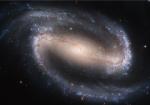 Barred Spiral Galaxy NGC 1300
12.01.2005
Big, beautiful barred spiral galaxy NGC 1300 lies some 70 million light-years away on the banks of the constellation Eridanus. This Hubble Space Telescope composite view of the gorgeous island universe was released...
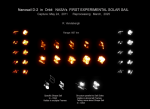 NanoSail D2
2.01.2026
In 2011, on January 20, NASA's NanoSail-D2 unfurled a very thin and very reflective 10 square meter sail becoming the first solar sail spacecraft in low Earth orbit. Often considered the stuff...
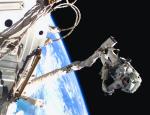 Astronaut at Work
31.05.2000
Did you ever have a day where everything got turned around and you just couldn't tell which way was up? Fortunately, this didn't happen to astronaut James S. Voss on May 21, who spent six hours preparing to fix and upgrade the International Space Station.
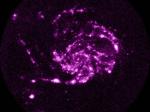 M101: An Ultraviolet View
10.06.2000
This picture of giant spiral galaxy Messier 101 (M101) was taken by the Ultraviolet Imaging Telescope (UIT). UIT flew into orbit as part of the Astro 2 mission on-board the Space Shuttle Endeavour in March 1995.
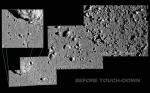 NEAR at Eros: Before Touchdown
24.08.2001
On 12 February, 2001, the NEAR-Shoemaker spacecraft gently touched-down on the the surface of Eros -- the first ever landing on an asteroid. During the descent, the spacecraft's camera recorded successive images of the diminutive world's surface, revealing fractured boulders, dust filled craters, and a mysterious collapsed channel.
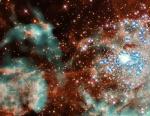 Star Cluster R136 Bursts Out
30.07.2001
In the center of star-forming region 30 Doradus lies a huge cluster of the largest, hottest, most massive stars known. Known as R136, the cluster's energetic stars are breaking out of the cocoon of gas and dust from which they formed.
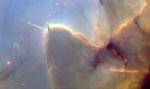 Trifid Pillars and Jets
30.12.2001
Dust pillars are like interstellar mountains. They survive because they are more dense than their surroundings, but they are being slowly eroded away by a hostile environment. Visible in the above picture...
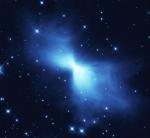 Cold Wind from the Boomerang Nebula
20.02.2003
A cold wind blows from the central star of the Boomerang Nebula. Seen here in a detailed false-color image recorded in 1998 by the Hubble Space Telescope, the nebula lies about 5,000 light-years away towards the grand southern constellation of Centaurus.
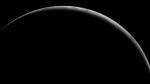 A Crescent Earth at Midnight
21.06.2003
The Earth's northern hemisphere is outlined as a sunlit crescent in this dramatic view from orbit, recorded near local midnight by the Geostationary Operational Environmental Satellite (GOES-8) on June 22, 1996. That...
|
January February March April May June July August September October |
|||||||||||||||||||||||||||||||||||||||||||||||||