
|
You entered: NASA
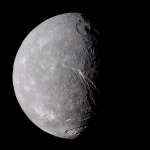 APOD: 2026 March 31 Б Uranus Largest Moon: Titania
30.03.2026
Titania's tortured terrain is a mix of canyons, cliffs, and craters. NASA's interplanetary robot spacecraft Voyager 2 passed the largest moon of Uranus in 1986 and took the feature picture. That...
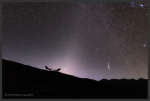 APOD: 2026 September 19 Б A Zodiacal Night
18.09.2026
Also known as the false dawn, a luminous band of zodiacal light is captured in this dark night skyscape. The serene view was recorded just before the beginning of astronomical twilight during September's star party at the remote Hanle Dark Sky Reserve, Ladakh, India, planet Earth.
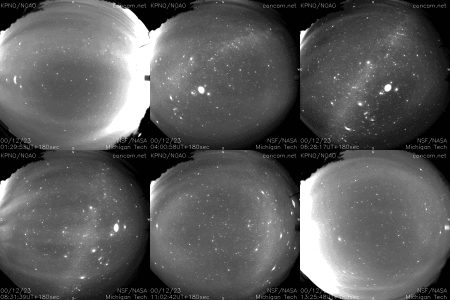 Watch the Sky Rotate
9.01.2001
If you could watch the sky for an entire night, what would you see? The above time-lapse sequence from the CONtinuous CAMera (CONCAM) project shows the answer for the skies above Kitt Peak National Observatory on 2000 December 23.
 Europa Rotating
15.01.2001
Evidence has been mounting that beneath the vast planes of ice that cover Europa lies water -- liquid oceans that might be home to alien life. The smallest of Jupiter's Galilean Moons (which include Io, Ganymede, and Callisto), Europa's deep interior is composed of mostly of silicate rock.
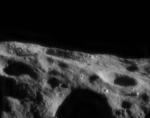 Eros At Sunset
24.08.2000
Gleaming in the rays of the setting sun, boulders litter the rugged surface of asteroid 433 Eros. The brightest boulder, at the edge of the large, shadowy crater near this picture's bottom center, is about 30 meters (100 feet) across.
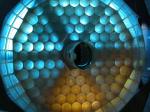 SOFIA s Mirror
22.10.2004
The candy-dish appearance of this high-tech astronomical mirror is striking. Made of a special glass ceramic material called Zerodur, it actually measures 2.7 meters across. The transparent surface has not yet received a reflective...
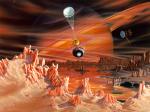 Titan Surmised
19.12.2004
What does the surface of Titan look like? Thick clouds have always made Saturn's largest moon so mysterious that seemingly farfetched hypotheses like methane rain and lakes have been seriously considered. Later this...
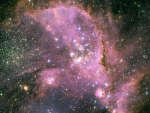 Young Stars of NGC 346
28.09.2008
The massive stars of NGC 346 are short lived, but very energetic. The star cluster is embedded in the largest star forming region in the Small Magellanic Cloud, some 210,000 light-years distant. Their...
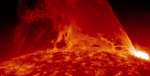 A Solar Prominence Eruption from SDO
25.05.2019
One of the most spectacular solar sights is an erupting prominence. In 2011, NASA's Sun-orbiting Solar Dynamic Observatory spacecraft imaged an impressively large prominence erupting from the surface. The dramatic explosion was captured in ultraviolet light in the featured time lapse video covering 90 minutes, where a new frame was taken every 24 seconds.
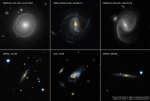 Spiral Galaxies Spinning Super Fast
4.11.2019
Why are these galaxies spinning so fast? If you estimated each spiral's mass by how much light it emits, their fast rotations should break them apart. The leading hypothesis as to why these galaxies don't break apart is dark matter -- mass so dark we can't see it.
|
January February March April May June July August September October |
|||||||||||||||||||||||||||||||||||||||||||||||||