
|
You entered: NASA
 APOD: 2025 March 9 Б Cyclones at Jupiters North Pole
9.03.2025
Why are there so many cyclones around the north pole of Jupiter? The topic is still being researched. NASA's robotic Juno mission orbiting Jupiter took data in 2018 that was used to construct this stunning view of the curious cyclones at Jupiter's north pole.
 Helios Helium
20.01.2001
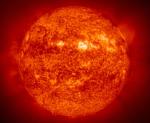
This image of the active Sun was made using ultraviolet light emitted by ionized Helium atoms in the Solar chromosphere. Helium was first discovered in the Sun in 1868, its name fittingly derived from from the Greek word Helios, meaning Sun. Credit for the discovery goes to astronomer Joseph Norman Lockyer (born May 17, 1836).
 Eros Craters And Boulders
21.07.2000
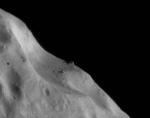
From a delicate orbit around asteroid 433 Eros, the NEAR Shoemaker spacecraft's camera has now imaged the entire surface of the small oddly-shaped world at least once. Recorded on July 7th from a distance of 50 kilometers, this dramatic view is about 1.8 kilometers across.
 SM3B: Mission to Hubble
14.03.2002
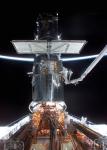
Now complete, Servicing Mission 3B (SM3B) was really the fourth trip to the Hubble Space Telescope, as the originally planned mission 3 was split into two parts. Falling around planet Earth, about 320 nautical...
 A High Energy Fleet
25.02.1996
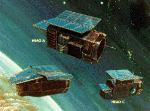
Looking like a fleet of futuristic starcruisers poised over planet Earth, NASA's highly successful series of High Energy Astrophysical Observatory (HEAO) spacecraft appear above in a vintage illustration. Labeled A, B, and C in this conceptual picture, the spacebased telescopes were known as HEAO-1, HEAO-2, and HEAO-3 respectively.
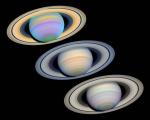 Saturn by Three
18.09.2003
These three views of Saturn were recorded by the Hubble Space Telescope on March 7th of this year, as the southern hemisphere of the solar system's most gorgeous planet reached its maximum 27 degree tilt toward Earth.
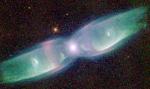 M2 9: Wings of a Butterfly Nebula
1.02.2004
Are stars better appreciated for their art after they die? Actually, stars usually create their most artistic displays as they die. In the case of low-mass stars like our Sun and M2-9 pictured above, the stars transform themselves from normal stars to white dwarfs by casting off their outer gaseous envelopes.
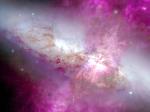 The Supergalactic Wind from Starburst Galaxy M82
1.06.2004
Star formation occurs at a faster pace in M82 -- a galaxy with about ten times the rate of massive star birth (and death) compared to our Milky Way. Winds from massive stars and blasts from supernova explosions have created a billowing cloud of expanding gas from this remarkable starburst galaxy.
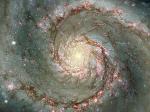 M51: The Whirlpool Galaxy in Dust and Stars
5.09.2004
The Whirlpool Galaxy is a classic spiral galaxy. At only 30 million light years distant and fully 60 thousand light years across, M51, also known as NGC 5194, is one of the brightest and most picturesque galaxies on the sky.
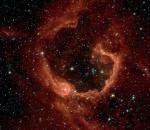 RCW 79: Stars in a Bubble
15.04.2005
A cosmic bubble of gas and dust, RCW 79 has grown to about 70 light-years in diameter, blown by the winds and radiation from hot young stars. Infrared light from the dust embedded in the nebula is tinted red in this gorgeous false-color view from the Spitzer Space Telescope.
|
January February March April May June July August September October |
|||||||||||||||||||||||||||||||||||||||||||||||||