
|
You entered: astronomer
 APOD: 2023 May 22 Б Supernova Discovered in Nearby Spiral Galaxy M101
22.05.2023
A nearby star has exploded and humanity's telescopes are turning to monitor it. The supernova, dubbed SN 2023ifx, was discovered by Japanese astronomer Koichi Itagaki three days ago and subsequently located on automated images from the Zwicky Transient Facility two days earlier.
 Barred Spiral Galaxy NGC 1365 from Webb
13.11.2024
A mere 56 million light-years distant toward the southern constellation Fornax, NGC 1365 is an enormous barred spiral galaxy about 200,000 light-years in diameter. That's twice the size of our own barred spiral Milky Way.
 APOD: 2025 January 14 Б North Star: Polaris and Surrounding Dust
14.01.2025
Why is Polaris called the North Star? First, Polaris is the nearest bright star toward the north spin axis of the Earth. Therefore, as the Earth turns, stars appear to revolve around Polaris, but Polaris itself always stays in the same northerly direction -- making it the North Star.
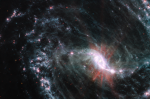 Barred Spiral Galaxy NGC 1365 from Webb
21.01.2026
A mere 56 million light-years distant toward the southern constellation Fornax, NGC 1365 is an enormous barred spiral galaxy about 200,000 light-years in diameter. That's twice the size of our own barred spiral Milky Way.
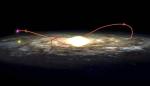 Where a Black Hole Roams
21.09.2001
Black hole candidate XTE J1118+480 is known to roam the halo of our Milky Way Galaxy. This exotic system - thought to be a stellar mass black hole consuming matter from a companion star - was discovered only last year as a flaring celestial x-ray source.
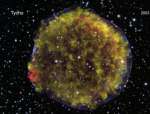 Tychos Supernova Remnant Expands
1.06.2016
What star created this huge expanding puffball? Featured here is the first expansion movie ever created for Tycho's supernova remnant, the result of a stellar explosion first recorded over 400 years ago by the famous astronomer Tycho Brahe.
 NGC 2392: Double Shelled Planetary Nebula
16.02.2020
To some, this huge nebula resembles a person's head surrounded by a parka hood. In 1787, astronomer William Herschel discovered this unusual planetary nebula: NGC 2392. More recently, the Hubble Space Telescope imaged the nebula in visible light, while the nebula was also imaged in X-rays by the Chandra X-ray Observatory.
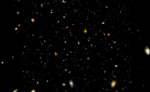 APOD: 2020 July 26 Б A Flight through the Hubble Ultra Deep Field
26.07.2020
What would it look like to fly through the distant universe? To find out, a team of astronomers estimated the relative distances to over 5,000 galaxies in one of the most distant fields of galaxies ever imaged: the Hubble Ultra Deep Field (HUDF).
 Microwave Hotspots: The Oldest Structures Known
29.10.2000
These spots are the oldest, most distant structures known. They are seen on the above two images of the microwave sky, north and south of our galaxy's equator, based on four-year's worth of data from NASA's COsmic Background Explorer (COBE) satellite (1989-1993). The spots represent temperature variations in the early universe.
 Centaurus A: Young Blue Star Stream
17.10.2002
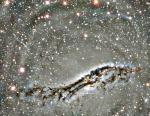
Almost lost in this cosmic jumble of stars, gas and dust is a faint but definite blue arc -- a stream of young stars whose formation was probably triggered as a small dwarf galaxy was torn apart approaching the giant elliptical galaxy Centaurus A.
|
January February March April May June July August |
||||||||||||||||||||||||||||||||||||||||||||||||||||||||