
|
You entered: astronomer
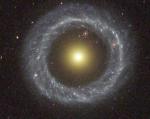 Hoags Object: A Strange Ring Galaxy
15.08.2004
Is this one galaxy or two? This question came to light in 1950 when astronomer Art Hoag chanced upon this unusual extragalactic object. On the outside is a ring dominated by bright blue stars, while near the center lies a ball of much redder stars that are likely much older.
 Carina Nebula Panorama from Hubble
23.06.2019
How do violent stars affect their surroundings? To help find out, astronomers created a 48-frame high-resolution, controlled-color panorama of the center of the Carina Nebula, one of the largest star forming regions on the night sky. The featured image, taken in 2007, was the most detailed image of the Carina Nebula yet taken.
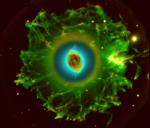 Halo of the Cat's Eye
1.11.2003
The Cat's Eye Nebula (NGC 6543) is one of the best known planetary nebulae in the sky. Its haunting symmetries are seen in the very central region of this stunning false-color picture, processed...
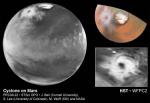 Cyclone on Mars
20.05.1999
Late last month a team of Mars-watching astronomers sighted an immense cyclonic storm system raging near the Red Planet's north pole. Their discovery picture, made with the Hubble Space Telescope on April 27, is seen at left while the projected insets (right) show closeups of the storm and surrounding areas.
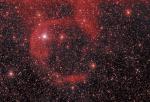 Alpha Cam: Runaway Star
24.11.2006
Runaway stars are massive stars traveling rapidly through interstellar space. Like a ship plowing through cosmic seas, runaway star Alpha Cam has produced this graceful arcing bow wave or bow shock - moving at over 60 kilometers per second and compressing the interstellar material in its path.
 Titania's Trenches
11.01.1997
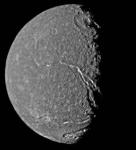
British astronomer Sir William Herschel discovered Titania and Oberon in 1787, 210 years ago today. He wasn't reading Shakespeare's A Midsummer Night's Dream though, he was making the first telescopic observations of moons of the planet Uranus (a planet which he himself discovered in 1781).
 Mars Then and Now
12.11.2003
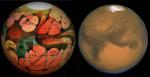
Does Mars have canals? A hot debate topic of the late 1800s, several prominent astronomers including Percival Lowell not only claimed to see an extensive system of long straight canals on Mars, but used them to indicate that intelligent life exists there.
 X Rays From Antennae Galaxies
3.02.2004
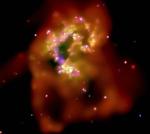
A bevy of black holes and neutron stars shine as bright, point-like sources against bubbles of million degree gas in this false-color x-ray image from the orbiting Chandra Observatory. The striking picture spans about...
 Supernova Survivor
12.02.2004
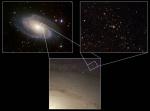
Beginning with a full view of beautiful spiral galaxy M81, follow the insets (left, bottom, then right) to zoom in on a real survivor. Seen at the center of the final field on the right is a star recently identified as the survivor of a cosmic cataclysm -- the supernova explosion of its companion star.
 Fornax Cluster in Motion
24.09.2004
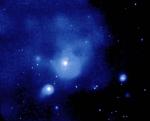
Reminiscent of popular images of the lovely Pleiades star cluster that lies within our own Milky Way Galaxy, this false-color x-ray view actually explores the center of a much more extended cosmic family -- the Fornax cluster of galaxies some 65 million light-years away.
|
January February March April May June July August |
||||||||||||||||||||||||||||||||||||||||||||||||||||||||