
|
You entered: astronomer
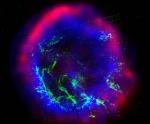 Supernova Remnant E0102 72 from Radio to X-Ray
14.04.2000
Not all stars form a big Q after they explode. The shape of supernova remnant E0102-72, however, is giving astronomers a clue about how tremendous explosions disperse elements and interact with surrounded gas. The above image is a composite of three different photographs in three different types of light.
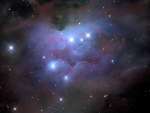 Reflections on the 1970s
20.12.2007
The 1970s are sometimes ignored by astronomers. In particular, this beautiful grouping of reflection nebulae in Orion - NGC 1977, NGC 1975, and NGC 1973 - are usually overlooked in favor of the substantial glow from the nearby stellar nursery better known as the Orion Nebula.
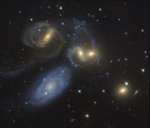 Stephan s Quintet
25.02.2012
The first identified compact galaxy group, Stephan's Quintet is featured in this eye-catching image constructed with data drawn from the extensive Hubble Legacy Archive. About 300 million light-years away, only four of these five galaxies are actually locked in a cosmic dance of repeated close encounters.
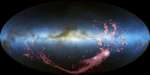 The Magellanic Stream
15.08.2013
In an astronomical version of the search for the source of the Nile, astronomers now have strong evidence for the origin of the Magellanic Stream. This composite image shows the long ribbon...
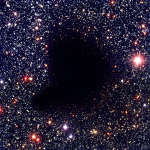 APOD: 2023 January 29 Б Barnard 68: Dark Molecular Cloud
29.01.2023
Where did all the stars go? What used to be considered a hole in the sky is now known to astronomers as a dark molecular cloud. Here, a high concentration of dust and molecular gas absorb practically all the visible light emitted from background stars.
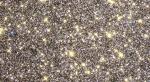 The Center of Globular Cluster Omega Centauri
10.10.2001
What is left over after stars collide? To help answer this question, astronomers have been studying the center of the most massive ball of stars in our Milky Way Galaxy. In the center of globular cluster Omega Centauri, stars are packed in 10,000 times more densely than near our Sun.
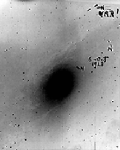 Andromeda Nebula: Var!
6.04.1996
In the 1920s, using photographic plates made with the Mt. Wilson Observatory's 100 inch telescope, Edwin Hubble determined the distance to the Andromeda Nebula - decisively demonstrating the existence of other galaxies far beyond the Milky Way.
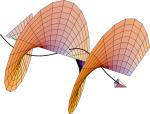 Light Can Twist as Well as Spin
19.11.2003
Light is more complicated than we thought. When astronomers measure light, they are usually concerned with its direction, energy, and spin polarization (sometimes). Recently, however, it has been more broadly realized that photons...
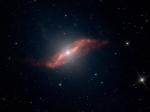 The Galaxy Within Centaurus A
24.06.2004
Peering deep inside Centaurus A, the closest active galaxy to Earth, the Spitzer Space Telescope's penetrating infrared cameras recorded this startling vista. About 1,000 light-years across, the twisted cosmic dust cloud apparently shaped like a parallelogram is likely the result of a smaller spiral galaxy falling into the giant Centaurus A.
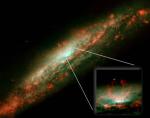 The Bubbling Cauldron of NGC 3079
16.10.2004
Edge-on spiral galaxy NGC 3079 is a mere 50 million light-years away toward the constellation Ursa Major. Shown in this stunning false-color Hubble Space Telescope image, the galaxy's disk - composed of spectacular star clusters in winding spiral arms and dramatic dark lanes of dust - spans some 70,000 light-years.
|
January February March April May June July August |
||||||||||||||||||||||||||||||||||||||||||||||||||||||||