
|
You entered: astronomer
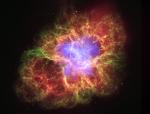 Composite Crab
26.10.2006
The Crab Nebula is cataloged as M1, the first object on Charles Messier's famous list of things which are not comets. In fact, the Crab is now known to be a supernova remnant, expanding debris from the death explosion of a massive star.
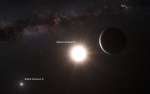 A View from Next Door
18.10.2012
Located just next door, Alpha Centauri is the closest star system to the Sun. A view from our interstellar neighbor a mere 4.3 light-years away is shown in this illustration. The Sun is at the upper right, a bright star against the background of the Milky Way.
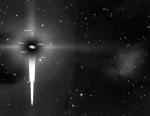 The Crab that Played with the Planet
10.01.2003
Wandering through the constellation Taurus, Saturn made its closest approach to planet Earth last month, tilting its lovely rings toward appreciative skygazers while rising high in midnight skies. On January 4th and 5th, Saturn...
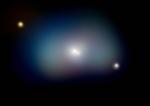 NGC 1700: Elliptical Galaxy and Rotating Disk
16.01.2003
In spiral galaxies, majestic winding arms of young stars and interstellar gas and dust rotate in a disk around a bulging galactic nucleus. Elliptical galaxies seem to be simpler, randomly swarming with old stars and lacking gas and dust.
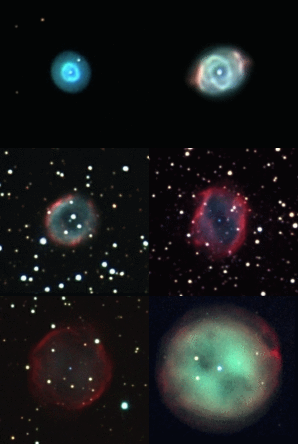 The Planetary Nebula Show
14.06.2003
What do the Owl, the Cat's Eye, the Ghost of Jupiter, and Saturn have in common? They're all planetary nebulae of course, glowing gaseous shrouds shed by dying sun-like stars as they run out of nuclear fuel.
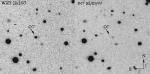 Historic Optical Flash Fades
22.04.1997
The largest telescopes in the world have scrambled to point toward this faint, fading object. Why? Because it may well be the first active optical counterpart ever found for a gamma-ray burst, and could hold the clue to the distance scale to this most enigmatic class of astronomical objects.
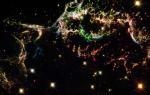 Recycling Cassiopeia A
30.08.2003
For billions of years, massive stars in our Milky Way Galaxy have lived spectacular lives. Collapsing from vast cosmic clouds, their nuclear furnaces ignite and create heavy elements in their cores. After a few million years, the enriched material is blasted back into interstellar space where star formation begins anew.
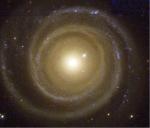 The Spiral Arms of NGC 4622
21.02.2004
While stirring a morning cup of coffee and thinking cosmic thoughts many astronomers would glance at this Hubble Space Telescope image of spiral galaxy NGC 4622 and assume that the galaxy was rotating counterclockwise in the picture.
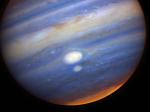 Jupiters Two Largest Storms Nearly Collide
25.07.2006
Two storms systems larger than Earth are nearly colliding right now on planet Jupiter. No one was sure what would happen, but so far both storms have survived. In the above false-color infrared image...
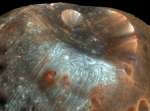 Stickney Crater
10.04.2008
Stickney Crater, the largest crater on the martian moon Phobos, is named for Chloe Angeline Stickney Hall, mathematician and wife of astronomer Asaph Hall. Asaph Hall discovered both the Red Planet's moons in 1877.
|
January February March April May June July August |
||||||||||||||||||||||||||||||||||||||||||||||||||||||||