
|
You entered: astronomer
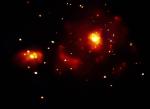 M51: X Rays from the Whirlpool
11.07.2002
Fresh from yesterday's episode, a popular pair of interacting galaxies known as the Whirlpool debut here beyond the realm of visible light -- imaged at high energies by the orbiting Chandra X-ray Observatory. Still turning in a remarkable performance, over 80 glitering x-ray stars are present in the Chandra image data from the region.
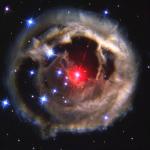 Light Echoes from V838 Mon
27.03.2003
Nominated for most mysterious star in the Milky Way, V838 Monocerotis briefly became one of the brightest stars in our galaxy. Its outburst discovered in January 2002, observations have indicated that V838 Mon somehow...
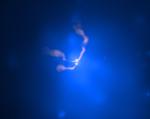 Binary Black Hole in 3C 75
12.04.2006
The two bright sources at the center of this composite x-ray (blue)/ radio (pink) image are co-orbiting supermassive black holes powering the giant radio source 3C 75. Surrounded by multimillion degree x-ray emitting gas, and blasting out jets of relativistic particles the supermassive black holes are separated by 25,000 light-years.
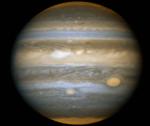 Jupiter and the Red Spots
5.05.2006
Jupiter's Great Red Spot is a swirling storm seen for over 300 years, since the beginning of telescopic observations. But in February 2006, planetary imager Christopher Go noticed it had been joined by Red Spot Jr - formed as smaller whitish oval-shaped storms merged and then developed the remarkable reddish hue.
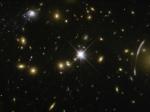 Illusion and Evolution in Galaxy Cluster Abell 2667
5.03.2007
What's happening to the galaxies of cluster Abell 2667? On the upper left, a galaxy appears to be breaking up into small pieces, while on the far right, another galaxy appears to be stretched like taffy.
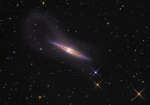 NGC 4013 and the Tidal Stream
7.02.2008
Nearly 50 million light-years away in the constellation Ursa Major, NGC 4013 was long considered an isolated island universe. Seen edge-on, the gorgeous spiral galaxy was known for its flattened disk and central bulge of stars, cut by silhouetted dust lanes.
 APOD: 2026 March 11 Б CG 4: The Globule and the Galaxy
11.03.2026
Is this a cosmic monster ready to devour an unsuspecting galaxy? Thankfully, that is not the case. The red БmonsterБ shown in the featured image is Cometary Globule CG 4, 1,300 light-years away in the Constellation Puppis.
 Hubble Telescope Maps Pluto
11.03.1996
No spacecraft from Earth has yet explored Pluto but astronomers have found ways of mapping its surface. A stunning map of this distant, diminutive planet, the first based on direct images, was revealed late last week in a Hubble Space Telescope press release.
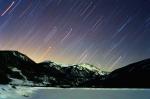 Orion Rising
25.12.2002
Orion always comes up sideways ... and was caught in the act earlier this month by astronomer Jimmy Westlake, stargazing eastward over the Rocky Mountains north of Leadville, Colorado, USA. To make this gorgeous image, Westlake placed his camera on a tripod for two exposures.
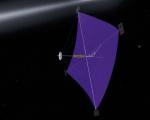 Solar Sail
21.08.2004
Could solar sailing become a future Olympic sport? Nearly 400 years ago astronomer Johannes Kepler observed comet tails blown by a solar breeze and suggested that vessels might likewise navigate through space using appropriately fashioned sails.
|
January February March April May June July August |
||||||||||||||||||||||||||||||||||||||||||||||||||||||||