
|
You entered: astronomer
 Time Tunnel
6.09.2007
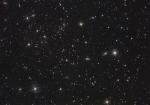
Spiky stars are nearby, but fuzzy galaxies are strewn far across the Universe in this cosmic view. Spanning about 1/2 degree on the sky, the pretty picture is the result of astronomer Johannes Schedler's project to look back in time, toward a quasar 12.7 billion light-years away.
 Giant Cluster Bends, Breaks Images
23.08.2009
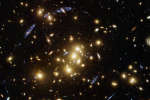
What are those strange blue objects? Many of the brightest blue images are of a single, unusual, beaded, blue, ring-like galaxy which just happens to line-up behind a giant cluster of galaxies. Cluster galaxies here typically appear yellow and -- together with the cluster's dark matter -- act as a gravitational lens.
 Stickney Crater
18.01.2013
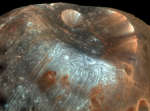
Stickney Crater, the largest crater on the martian moon Phobos, is named for Chloe Angeline Stickney Hall, mathematician and wife of astronomer Asaph Hall. Asaph Hall discovered both the Red Planet's moons in 1877.
 M31 versus M33
25.09.2015
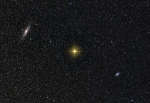
Separated by about 14 degrees (28 Full Moons) in planet Earth's sky, spiral galaxies M31 at left, and M33 are both large members of the Local Group, along with our own Milky Way galaxy.
 Comet 57P Falls to Pieces
2.08.2002
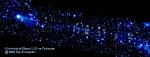
Comet 57P has fallen to pieces, at least 19 of them. Orbiting the Sun every 5.9 years or so this faint comet - also christened Comet 57P/du Toit-Neujmin-Delporte for its three 1941 co-discoverers - is simply...
 Snake in the Dark
19.02.2009
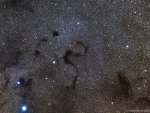
Dark nebulae snake across a gorgeous expanse of stars in this telescopic view toward the pronounceable constellation Ophiuchus and the center of our Milky Way Galaxy. In fact, the twisting central shape seen here is well known as the Snake Nebula.
 The Whale Galaxy
2.05.2009
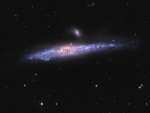
NGC 4631 is a big beautiful spiral galaxy. Seen edge-on, it lies only 25 million light-years away in the well-trained northern constellation Canes Venatici. The galaxy's slightly distorted wedge shape suggests to some a cosmic herring and to others its popular moniker, The Whale Galaxy.
 M95: Spiral Galaxy with an Inner Ring
28.05.2019
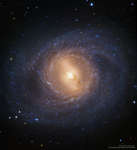
Why do some spiral galaxies have a ring around the center? First and foremost, M95 is one of the closer examples of a big and beautiful barred spiral galaxy. Visible in the featured combination...
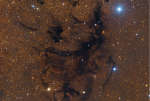 LDN 673: Dark Clouds in Aquila
28.10.2022
Part of a dark expanse that splits the crowded plane of our Milky Way galaxy, the Aquila Rift arcs through planet Earth's skies near bright star Altair. In eerie silhouette against the Milky...
 APOD: 2024 January 1 Б NGC 1232: A Grand Design Spiral Galaxy
31.12.2023
Galaxies are fascinating not only for what is visible, but for what is invisible. Grand spiral galaxy NGC 1232, captured in detail by one of the Very Large Telescopes, is a good example.
|
January February March April May June July August |
||||||||||||||||||||||||||||||||||||||||||||||||||||||||