
|
You entered: astronomer
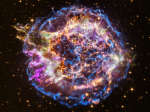 Recycling Cassiopeia A
23.01.2021
Massive stars in our Milky Way Galaxy live spectacular lives. Collapsing from vast cosmic clouds, their nuclear furnaces ignite and create heavy elements in their cores. After a few million years, the enriched material is blasted back into interstellar space where star formation can begin anew.
 Recycling Cassiopeia A
1.06.2023
Massive stars in our Milky Way Galaxy live spectacular lives. Collapsing from vast cosmic clouds, their nuclear furnaces ignite and create heavy elements in their cores. After a few million years, the enriched material is blasted back into interstellar space where star formation can begin anew.
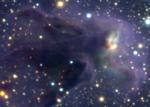 M16: Infrared Star Hunt
4.01.2002
The head of an interstellar gas and dust cloud is shown here in false-color, a near-infrared view recorded by astronomers hunting for stars within M16's Eagle Nebula. Made famous in a 1995 Hubble...
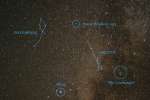 Nova Delphini 2013
16.08.2013
Using a small telescope to scan the skies on August 14, Japanese amateur astronomer Koichi Itagaki discovered a "new" star within the boundaries of the constellation Delphinus. Indicated in this skyview captured on August 15 from Stagecoach, Colorado, it is now appropriately designated Nova Delphini 2013.
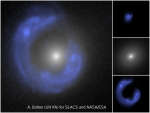 SDSSJ1430: A Galaxy Einstein Ring
28.07.2008
What's large and blue and can wrap itself around an entire galaxy? A gravitational lens mirage. Pictured above on the left, the gravity of a normal white galaxy has gravitationally distorted the light from a much more distant blue galaxy.
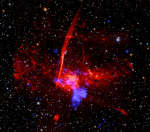 APOD: 2026 June 18 Б Possible Supernova Remnant in Galactic Center
18.06.2026
Do you see that blue blob to the lower right of the image center? Astronomers think that it shows where a massive star exploded as a supernova whose light reached Earth 1,700 years ago.
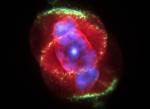 X-rays From The Cat's Eye
11.01.2001
Haunting patterns within planetary nebula NGC 6543 readily suggest its popular moniker -- the Cat's Eye nebula. In 1995, a stunning false-color optical image from the Hubble Space Telescope detailed the swirls of this glowing nebula, known to be the gaseous shroud expelled from a dying sun-like star about 3,000 light-years from Earth.
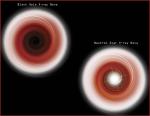 Black Holes Are Black
19.01.2001
Q: Why are black holes black? A: Because they have an event horizon. The event horizon is that one-way boundary predicted by general relativity beyond which nothing, not even light, can return. X-ray astronomers...
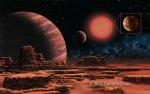 Gliese 876 System Includes Large Terrestrial Planet
14.06.2005
Is our Earth unique? In continuing efforts to answer this question, astronomers have now discovered an Earth-like planet orbiting a distant normal star. Previously over 150 gas-giant planets like Jupiter had been so discovered.
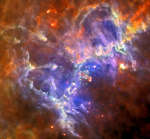 Inside the Eagle Nebula
3.02.2012
In 1995, a now famous picture from the Hubble Space Telescope featured Pillars of Creation, star forming columns of cold gas and dust light-years long inside M16, the Eagle Nebula. This remarkable false-color composite image revisits the nearby stellar nursery with image data from the orbiting Herschel Space Observatory and XMM-Newton telescopes.
|
January February March April May June July August |
||||||||||||||||||||||||||||||||||||||||||||||||||||||||