
|
You entered: astronomer
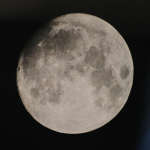 21st Century Wet Collodion Moon
2.01.2021
In the mid 19th century, one of the first photographic technologies used to record the lunar surface was the wet-plate collodion process, notably employed by British astronomer Warren De la Rue. To capture...
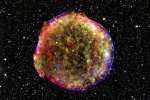 Tychos Supernova Remnant
17.03.2009
What star created this huge puffball? Pictured above is the best multi-wavelength image yet of Tycho's supernova remnant, the result of a stellar explosion first recorded over 400 years ago by the famous astronomer Tycho Brahe.
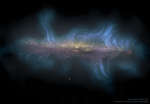 The Vertical Magnetic Field of NGC 5775
27.01.2021
How far do magnetic fields extend up and out of spiral galaxies? For decades astronomers knew only that some spiral galaxies had magnetic fields. However, after NRAO's Very Large Array (VLA) radio telescope...
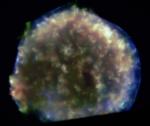 X Rays From Tycho s Supernova Remnant
22.05.2004
In 1572, Danish astronomer Tycho Brahe recorded the sudden appearance of a bright new star in the constellation Cassiopeia. The new star faded from view over a period of months and is believed to have been a supernova, one of the last stellar explosions seen in our Milky Way galaxy.
 Gamma Ray Earth
31.03.2005
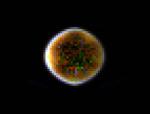
The pixelated planet above is actually our own planet Earth seen in gamma rays - the most energetic form of light. In fact, the gamma rays used to construct this view pack over 35 million electron volts (MeV) compared to a mere two electron volts (eV) for a typical visible light photon.
 The Whirlpool Galaxy in Infrared Dust
26.01.2011
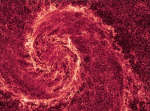
How do spiral galaxies form stars? To help find out, the Hubble Space Telescope imaged the nearby photogenic spiral M51 in infrared light to highlight the dust that traces the dense gas that best forms stars. To further isolate the dust, much of the optical light from stars has also been digitally removed.
 Julius Caesar and Leap Days
29.02.2016
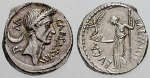
Today, February 29th, is a leap day - a relatively rare occurrence. In 46 BC, Julius Caesar, featured here in a self-decreed minted coin, created a calendar system that added one leap day every four years.
 Two Black Holes Dancing in 3C 75
22.10.2017
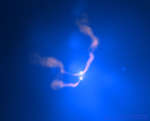
What's happening at the center of active galaxy 3C 75? The two bright sources at the center of this composite x-ray (blue)/ radio (pink) image are co-orbiting supermassive black holes powering the giant radio source 3C 75.
 The 47 Ursae Majoris System
17.08.2001
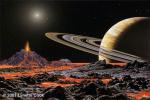
Watching and waiting, astronomers have uncovered the presence of more than 70 planets orbiting stars other than the Sun. So far almost all these extrasolar planets have crazy elongated orbits, lie uncomfortably close to their parent stars, or are found in bizarre, inhospitable systems.
 Hoags Object: A Strange Ring Galaxy
28.07.2013
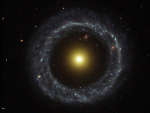
Is this one galaxy or two? This question came to light in 1950 when astronomer Art Hoag chanced upon this unusual extragalactic object. On the outside is a ring dominated by bright blue stars, while near the center lies a ball of much redder stars that are likely much older.
|
January February March April May June July August |
||||||||||||||||||||||||||||||||||||||||||||||||||||||||