
|
You entered: astronomer
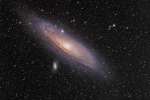 Andromeda Island Universe
8.01.2010
The most distant object easily visible to the eye is M31, the great Andromeda Galaxy some two and a half million light-years away. But without a telescope, even this immense spiral galaxy - spanning over 200,000 light years - appears as a faint, nebulous cloud in the constellation Andromeda.
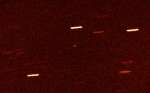 A 2017 U1: An Interstellar Visitor
2.11.2017
Traveling at high velocity along an extreme hyperbolic orbit and making a hairpin turn as it swung past the Sun, the now designated A/2017 U1 is the first known small body from interstellar space.
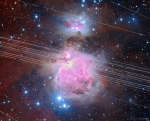 Starlink over Orion
31.05.2021
What are those streaks across Orion? Most are reflections of sunlight from numerous Earth-orbiting Starlink satellites. Appearing by eye as a series of successive points floating across a twilight sky, the increasing number of SpaceX Starlink communication satellites are causing concern among many astronomers.
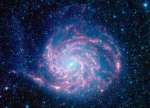 Spitzer s M101
29.12.2009
Big, beautiful spiral galaxy M101 is one of the last entries in Charles Messier's famous catalog, but definitely not one of the least. About 170,000 light-years across, this galaxy is enormous, almost twice the size of our own Milky Way Galaxy.
 South of Orion
26.01.2022
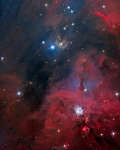
South of the large star-forming region known as the Orion Nebula, lies bright blue reflection nebula NGC 1999. At the edge of the Orion molecular cloud complex some 1,500 light-years distant, NGC 1999's illumination is provided by the embedded variable star V380 Orionis.
 APOD: 2024 February 18 Б Hoags Object: A Nearly Perfect Ring Galaxy
17.02.2024
Is this one galaxy or two? This question came to light in 1950 when astronomer Arthur Hoag chanced upon this unusual extragalactic object. On the outside is a ring dominated by bright blue stars, while near the center lies a ball of much redder stars that are likely much older.
 X rays From HCG 62
8.03.2001
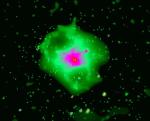
Scanning the skies for galaxies Canadian astronomer Paul Hickson and colleagues identified some 100 compact groups of galaxies, now appropriately called Hickson Compact Groups (HCGs). With only a few member galaxies per group, HCGs...
 Two Black Holes Dancing in 3C 75
8.11.2008
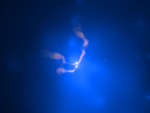
What's happening at the center of active galaxy 3C 75? The two bright sources at the center of this composite x-ray (blue)/ radio (pink) image are co-orbiting supermassive black holes powering the giant radio source 3C 75.
 La Superba
17.12.2008
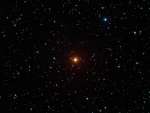
Y Canum Venaticorum (Y CVn) is a very rare star in planet Earth's night sky. It's also very red, exhibiting such a remarkable spectrum of light, 19th century astronomer Angelo Secchi dubbed it La Superba.
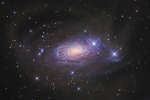 Star Streams and the Sunflower Galaxy
11.09.2010
A bright spiral galaxy of the northern sky, Messier 63 is about 25 million light-years distant in the loyal constellation Canes Venatici. Also cataloged as NGC 5055, the majestic island universe is nearly 100,000 light-years across, about the size of our own Milky Way.
|
January February March April May June July August |
||||||||||||||||||||||||||||||||||||||||||||||||||||||||