
|
You entered: astronomer
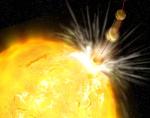 HD 82943: Planet Swallower
18.05.2001
Stars like HD 82943 are main sequence G dwarf stars with temperatures and compositions similar to the Sun. Also like the Sun, HD 82943 is known to have at least two giant planets, but unlike gas giants in our solar system their orbits are not nearly circular and bring them closer to the parent star.
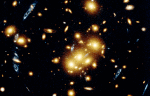 Giant Cluster Bends, Breaks Images
14.06.1998
What are those strange blue objects? Many are images of a single, unusual, beaded, blue, ring-like galaxy which just happens to line-up behind a giant cluster of galaxies. Cluster galaxies here appear yellow and -- together with the cluster's dark matter -- act as a gravitational lens.
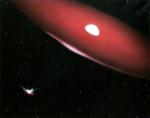 Phi Persei: Double Star
2.10.1999
It's clear who is the biggest star in this binary system. Based on recent results, this artist's vision of the double star Phi Persei, 720 light years away, shows a bright, rapidly rotating massive star surrounded by a disk of gas. A small companion star orbits 100 million miles away.
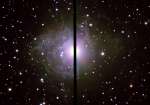 Echoes from RS Pup
12.02.2008
This dusty reflection nebula surrounds pulsating star RS Pup, some 10 times more massive than the Sun and on average 15,000 times more luminous. In fact, RS Pup is a Cepheid type variable...
 Two Planet Opposition
8.10.2010
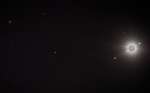
In late September, two planets were opposite the Sun in Earth's sky, Jupiter and Uranus. Consequently closest to Earth, at a distance of only 33 light-minutes and 2.65 light-hours respectively, both were good targets for telescopic observers.
 Two Black Holes Dancing in 3C 75
5.06.2022
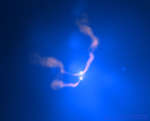
What's happening at the center of active galaxy 3C 75? The two bright sources at the center of this composite x-ray (blue)/ radio (pink) image are co-orbiting supermassive black holes powering the giant radio source 3C 75.
 Young Star Clusters in an Old Galaxy
4.07.2002
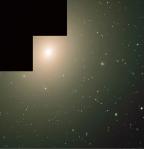
Elliptical galaxy NGC 4365 is old, probably about 12 billion years old. Like most elliptical galaxies, this galaxy was thought to be full of old stars too, its burst of star forming activity having long since ended.
 Giant Cluster Bends, Breaks Galaxy Images
3.05.1997
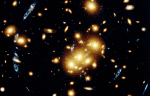
What are those strange blue objects? Many are images of a single, unusual, beaded, blue, ring-like galaxy which just happens to line-up behind a giant cluster of galaxies. Cluster galaxies here appear yellow and -- together with the cluster's dark matter -- act as a gravitational lens.
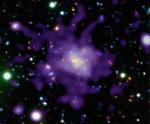 Galaxy Cluster in the Early Universe
26.02.2004
Long before medieval alchemists dreamed of transmuting base metals to gold, stellar furnaces in this massive cluster of galaxies - cataloged as RDCS 1252.9-2927 - had transformed light elements into heavy ones. In the false-color composite image individual cluster galaxies can be seen at optical and near-infrared wavelengths, shown in red, yellow, and green colors.
 M31 versus M33
26.09.2013
Separated by about 14 degrees (28 Full Moons) in planet Earth's sky, spiral galaxies M31 ,left, and M33 are both large members of the Local Group, along with our own Milky Way galaxy.
|
January February March April May June July August |
||||||||||||||||||||||||||||||||||||||||||||||||||||||||