
|
You entered: astronomer
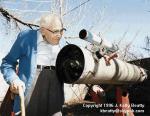 Clyde W. Tombaugh: 1906-1997
4.02.1997
Astronomer Clyde Tombaugh, discoverer of Pluto, died on January 17th. Inspiring many during his long and exceptional career, he had been living in Las Cruces, New Mexico with his wife of 60 years, Patsy. Today would have been his 91st birthday.
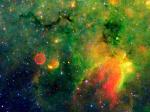 A Galactic Star Forming Region in Infrared
24.09.2007
How do stars form? To help study this complex issue, astronomers took a deep image in infrared light of an active part of our Milky Way Galaxy where star formation is rampant. In IRDC G11.11-0
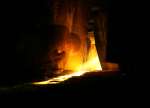 Solstice at Newgrange
20.12.2008
Tomorrow's solstice marks the southernmost point of the Sun's annual motion through planet Earth's sky and the astronomical beginning of winter in the north. In celebration of the northern winter solstice...
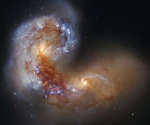 Spiral Galaxy NGC 4038 in Collision
12.08.2012
This galaxy is having a bad millennium. In fact, the past 100 million years haven't been so good, and probably the next billion or so will be quite tumultuous. Visible on the upper...
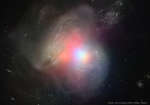 Arp 299: Black Holes in Colliding Galaxies
1.11.2016
Is only one black hole spewing high energy radiation -- or two? To help find out, astronomers trained NASA's Earth-orbiting NuSTAR and Chandra telescopes on Arp 299, the enigmatic colliding galaxies expelling the radiation.
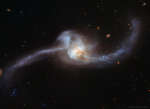 NGC 2623: Merging Galaxies from Hubble
10.01.2018
Where do stars form when galaxies collide? To help find out, astronomers imaged the nearby galaxy merger NGC 2623 in high resolution with the Hubble Space Telescope. Analysis of this and other Hubble images...
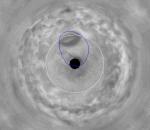 Jupiter's Great Dark Spot
19.03.2003
Seventeenth century astronomer Giovanni Domenico Cassini was an astute observer of Jupiter's Great Red Spot. So it seems only fitting that his namesake, the Cassini spacecraft, has enabled detailed observations of another planet-sized blemish -- Jupiter's Great Dark Spot.
 Jupiter and Saturn Pas de Deux
20.12.2001
Viewed from Earth, the solar system's planets do a cosmic dance that is hard to appreciate on any single night. But consider this well planned animated sequence combining 23 pictures taken at approximately 2 week intervals from June 2000 through May 2001.
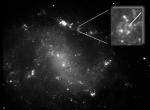 ESO 184 G82: and the Supernova Gamma Ray Burst Connection
28.02.2002
Modern astronomers keep a long list of things that go bump in the night. Near the top are supernovae - the death explosions of massive stars, and gamma-ray bursts - the most powerful explosions seen across the Universe.
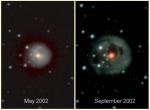 V838 Mon: Mystery Star
3.10.2002
A leading candidate for the most mysterious star found in recent times is variable star V838 Monocerotis. At a distance of about 8,000 light-years, V838 Mon was discovered to be in outburst in January of this year.
|
January February March April May June July August |
||||||||||||||||||||||||||||||||||||||||||||||||||||||||