
|
You entered: astronomer
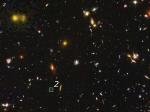 Building Galaxies in the Early Universe
10.09.2007
What was the very early universe like? To help find out, astronomers pointed the Hubble Space Telescope between bright nearby objects to create one of the deepest images ever -- the Hubble Ultra Deep Field (HUDF). The resulting HUDF is like a jewel box of strange and distant galaxies.
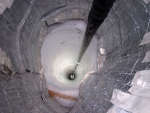 Ice Fishing for Cosmic Neutrinos
12.02.2011
Scientists are melting holes in the bottom of the world. In fact, almost 100 holes melted near the South Pole are now being used as astronomical observatories. Astronomers with the IceCube Neutrino Observatory lowered into each vertical lake a long string knotted with basketball-sized light detectors. The water in each hole soon refreezes.
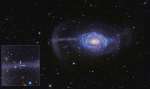 NGC 4651: The Umbrella Galaxy
2.07.2014
Spiral galaxy NGC 4651 is a mere 62 million light-years distant, toward the well-groomed northern constellation Coma Berenices. About the size of our Milky Way, this island universe is seen to have a faint umbrella-shaped structure that seems to extend (left) some 100 thousand light-years beyond the bright galactic disk.
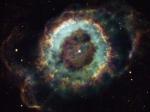 NGC 6369: The Little Ghost Nebula
7.11.2002
This pretty planetary nebula, cataloged as NGC 6369, was discovered by 18th century astronomer William Herschel as he used a telescope to explore the constellation Ophiucus. Round and planet-shaped, the nebula is also relatively faint and has acquired the popular moniker of Little Ghost Nebula.
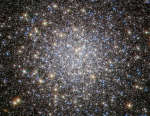 Hubble s Messier 5
3.11.2017
"Beautiful Nebula discovered between the Balance [Libra] & the Serpent [Serpens] ..." begins the description of the 5th entry in 18th century astronomer Charles Messier's famous catalog of nebulae and star clusters. Though it appeared...
 Jupiter in Infrared from Gemini
12.05.2020
In infrared, Jupiter lights up the night. Recently, astronomers at the Gemini North Observatory in Hawaii, USA, created some of the best infrared photos of Jupiter ever taken from EarthБs surface, pictured. Gemini...
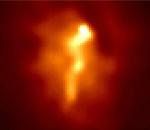 Abell 1795: A Galaxy Cluster s Cooling Flow
7.12.2000
Throughout the Universe, galaxies tend to swarm in groups ranging from just a handful of members to casts of thousands. Astronomers have realized since the early 1970s that the larger swarms, immense clusters of galaxies millions of light-years across, are immersed within tenuous clouds of hot gas which glow strongly in x-rays.
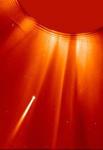 SOHO Sungrazer
1.09.2000
SOHO, the space-based SOlar and Heliospheric Observatory, has become by far the reigning champion facility for discovering comets, its total having recently reached 200. As might be expected of a solar observatory, most of the SOHO discovered comets are sungrazers, destined to dive within a mere 50 thousand kilometers or so of the solar photosphere.
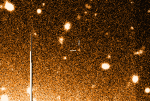 The Farthest Explosion Yet Measured
19.10.2000
It happened so far away that common human distance measures are inadequate to describe it. Furthermore, astronomers do not even claim to know exactly what happened. What is known is that satellites across our Solar System reported on 2000 January 31 a tremendous explosion of gamma rays had occurred towards some previously uninteresting direction.
 M16: Stars, Pillars and the Eagle s EGGs
2.01.2002
The Hubble Space Telescope's 1995 image of pillars of dust and gas, light-years long, within the Eagle Nebula (M16) was sensational. The three prominent pillars in that close-up visible light picture also appear...
|
January February March April May June July August |
||||||||||||||||||||||||||||||||||||||||||||||||||||||||