
|
You entered: astronomer
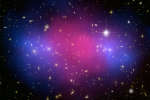 MACSJ0025: Two Giant Galaxy Clusters
Collide
MACSJ0025: Two Giant Galaxy Clusters
Collide
17.09.2008
What happens when two of the largest objects in the universe collide? No one was quite sure, but the answer is giving clues to the nature of mysterious dark matter. In the case of MACSJ0025.
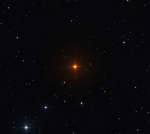 R Leporis: A Vampire's Star
31.10.2018
Better known as Hind's Crimson Star, R Leporis is a rare star in planet Earth's night sky. It's also a shocking shade of red. The star's discoverer, 19th century English...
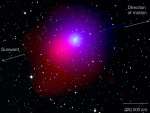 The Swift View of Comet Lulin
21.02.2009
Now growing brighter, Comet Lulin is headed for its closest approach to planet Earth early next week. But the comet's greenish glow, familiar to earthbound skygazers, is replaced by false colors in this premier view from the orbiting Swift satellite.
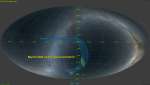 LIGO Virgo GW170814 Skymap
28.09.2017
From around planet Earth three gravitational wave detectors have now reported a joint detection of ripples in spacetime, the fourth announced detection of a binary black hole merger in the distant Universe. The event...
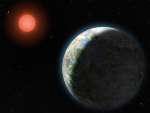 Zarmina s World
1.10.2010
A mere 20 light-years away in the constellation Libra, red dwarf star Gliese 581 has received much scrutiny by astronomers in recent years. Earthbound telescopes had detected the signatures of multiple planets orbiting...
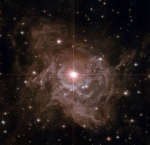 Nearby Cepheid Variable RS Pup
9.09.2013
It is one of the most important stars in the sky. This is partly because, by coincidence, it is surrounded by a dazzling reflection nebula. Pulsating RS Puppis, the brightest star in the image center, is some ten times more massive than our Sun and on average 15,000 times more luminous.
 Julius Caesar and Leap Days
29.02.1996
Today, February 29th, is a leap day - a relatively rare occurrence. Advised by Alexandrian astronomer Sosigenes, Roman dictator Julius Caesar, pictured above in a self-decreed minted coin, created a calender system in 46 BC that contained one leap day every four years.
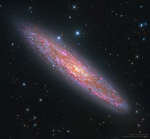 NGC 253: The Silver Coin Galaxy
14.04.2020
NGC 253 is one of the brightest spiral galaxies visible, but also one of the dustiest. Dubbed the Silver Coin for its appearance in smalltelescopes, it is more formally known as the Sculptor Galaxy for its location within the boundaries of the southern constellation Sculptor.
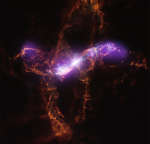 Symbiotic R Aquarii
5.02.2022
Variable star R Aquarii is actually an interacting binary star system, two stars that seem to have a close symbiotic relationship. Centered in this space-based optical/x-ray composite image it lies about 710 light years away.
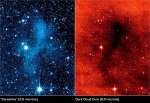 Coreshine from a Dark Cloud
30.09.2010
Stars and their planets are born in cold, dark, interstellar clouds of gas and dust. While exploring the clouds at infrared wavelengths, astronomers have made a surprising discovery -- dozens of cases where dense cloud cores shine by reflecting infrared starlight.
|
January February March April May June July August |
||||||||||||||||||||||||||||||||||||||||||||||||||||||||