
|
You entered: astronomer
 Welcome to the International Year of Astronomy
1.01.2009
Astronomers all over planet Earth invite you to experience the night sky as part of the International Year of Astronomy 2009. This year was picked by the International Astronomical Union and the United Nations Educational, Scientific, and Cultural Organization because it occurs 400 years after Galileo turned one of the first telescopes toward the heavens.
 Dark Markings of the Sky
25.04.2009
Based on wide field photographs, American astronomer Edward Emerson Barnard cataloged the dark markings of the sky in the early 20th century. Barnard's markings are dark nebulae, interstellar clouds of obscuring gas and dust.
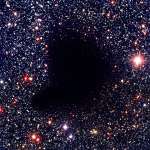 Molecular Cloud Barnard 68
23.06.2009
Where did all the stars go? What used to be considered a hole in the sky is now known to astronomers as a dark molecular cloud. Here, a high concentration of dust and molecular gas absorb practically all the visible light emitted from background stars.
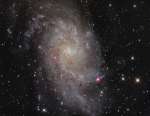 M33: Triangulum Galaxy
3.12.2010
The small, northern constellation Triangulum harbors this magnificent face-on spiral galaxy, M33. Its popular names include the Pinwheel Galaxy or just the Triangulum Galaxy. M33 is over 50,000 light-years in diameter, third largest in the Local Group of galaxies after the Andromeda Galaxy (M31), and our own Milky Way.
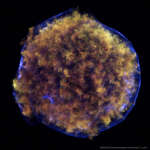 Tychos Supernova Remnant in Xray
13.01.2019
What star created this huge puffball? What's pictured is the hot expanding nebula of Tycho's supernova remnant, the result of a stellar explosion first recorded over 400 years ago by the famous astronomer Tycho Brahe. The featured image is a composite of three X-ray colors taken by the orbiting Chandra X-ray Observatory.
 APOD: 2023 October 17 Б PDS 70: Disk, Planets, and Moons
17.10.2023
It's not the big ring that's attracting the most attention. Although the big planet-forming ring around the star PDS 70 is clearly imaged and itself quite interesting. It's also not the planet on the right, just inside the big disk, thatБs being talked about the most.
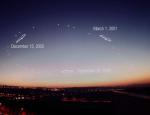 Venus Evening Loop
1.06.2001
From September 2000 through March 2001, astronomer Tunc Tezel patiently photographed the planet Venus on 25 different dates as it wandered through the evening twilight. The pictures were taken from the same spot...
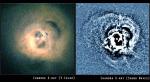 A Note on the Perseus Cluster
12.09.2003
A truly enormous collection of thousands of galaxies, the Perseus Cluster - like other large galaxy clusters - is filled with hot, x-ray emitting gas. The x-ray hot gas (not the individual galaxies) appears in the left panel above, a false color image from the Chandra Observatory.
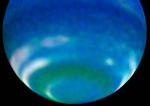 Neptune: Still Springtime After All These Years
26.06.2004
In the 1960s spring came to the southern hemisphere of Neptune, the Solar System's outermost gas giant planet. Of course, since Neptune orbits the Sun once every 165 earth-years, it's still springtime for southern Neptune, where each season lasts over four decades.
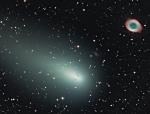 Comet Meets Ring Nebula: Part I
11.05.2006
As dawn approached on May 8, astronomer Stefan Seip carefully watched Fragment C of broken comet 73P/Schwassmann-Wachmann 3 approach M57 - the Ring Nebula, and faint spiral galaxy IC 1296. Of course, even though...
|
January February March April May June July August |
||||||||||||||||||||||||||||||||||||||||||||||||||||||||