
|
You entered: astronomer
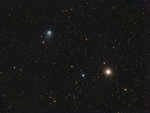 Comet Garradd and Messier 15
6.08.2011
Recorded on August 2, this telescopic composite image catches Comet Garradd (C/2009 P1) in the same field of view as globular star cluster M15. The celestial scene would have been a rewarding one for influential 18th century comet hunter Charles Messier.
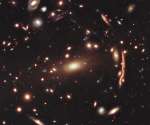 MACS 1206: A Galaxy Cluster Gravitational Len
17.10.2011
It is difficult to hide a galaxy behind a cluster of galaxies. The closer cluster's gravity will act like a huge lens, pulling images of the distant galaxy around the sides and greatly distorting them.
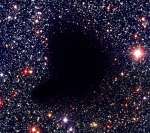 Molecular Cloud Barnard 68
13.12.2014
Where did all the stars go? What used to be considered a hole in the sky is now known to astronomers as a dark molecular cloud. Here, a high concentration of dust and molecular gas absorb practically all the visible light emitted from background stars.
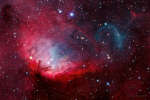 The Tulip and Cygnus X 1
16.02.2017
Framing a bright emission region, this telescopic view looks out along the plane of our Milky Way Galaxy toward the nebula rich constellation Cygnus the Swan. Popularly called the Tulip Nebula, the reddish glowing cloud of interstellar gas and dust is also found in the 1959 catalog by astronomer Stewart Sharpless as Sh2-101.
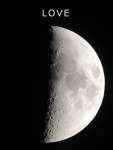 Lunar LOVE
3.11.2018
A more creative search by a group of amateur astronomers in the Ehime Prefecture of Shikoku Island, Japan has found lunar L-O-V-E. Their secret was an examination of this sharp image of the First Quarter Moon.
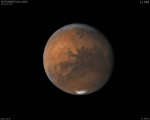 Solis Lacus: The Eye of Mars
1.10.2020
As telescopes around planet Earth watch, Mars is growing brighter in night skies, approaching its 2020 opposition on October 13. Mars looks like its watching too in this view of the Red Planet from September 22.
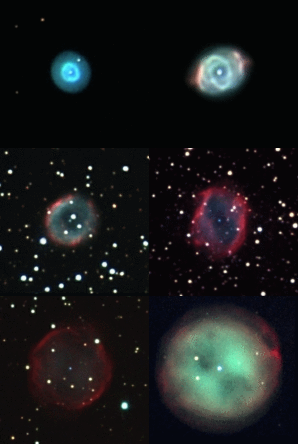 The Planetary Nebula Show
3.10.2001
What do the Owl, the Cat's Eye, the Ghost of Jupiter, and Saturn have in common? They're all planetary nebulae of course(!), glowing gaseous shrouds shed by dying sun-like stars as they run out of nuclear fuel.
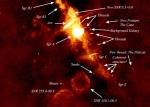 The Galactic Center A Radio Mystery
3.08.2002
Tuning in to the center of our Milky Way galaxy, radio astronomers explore a complex, mysterious place. A premier high resolution view, this startlingly beautiful picture covers a 4x4 degree region around the galactic center.
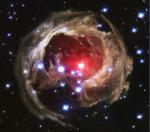 V838 Mon: Echoes from the Edge
5.03.2004
Variable star V838 Monocerotis lies near the edge of our Milky Way Galaxy, about 20,000 light-years from the Sun. Still, ever since a sudden outburst was detected in January 2002, this enigmatic star...
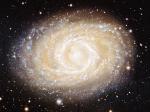 Barred Spiral Galaxy M95
14.03.2007
Why do some spiral galaxies have a ring around the center? First and foremost, M95 is one of the closer examples of a big and beautiful barred spiral galaxy. Visible in the above recent...
|
January February March April May June July August |
||||||||||||||||||||||||||||||||||||||||||||||||||||||||