
|
You entered: astronomer
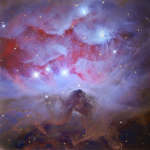 Reflections on the 1970s
13.01.2016
The 1970s are sometimes ignored by astronomers, like this beautiful grouping of reflection nebulae in Orion - NGC 1977, NGC 1975, and NGC 1973 - usually overlooked in favor of the substantial glow from the nearby stellar nursery better known as the Orion Nebula.
 Trifid, Lagoon, and Mars
6.10.2016
Bright nebulae and star clusters along this 5 degree wide field of view are popular stops on telescopic tours of the constellation Sagittarius and the crowded starfields of the central Milky Way. Cataloged...
 Cat s Eye Wide and Deep
25.05.2023
The Cat's Eye Nebula (NGC 6543) is one of the best known planetary nebulae in the sky. Its more familiar outlines are seen in the brighter central region of the nebula in this impressive wide-angle view. But this wide and deep image combining data from two telescopes also reveals its extremely faint outer halo.
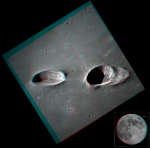 APOD: 2026 May 9 Б Messier Craters in Stereo
9.05.2026
Many bright nebulae and star clusters in planet Earth's sky are associated with the name of astronomer Charles Messier from his famous 18th century catalog. His name is also given to these two large and remarkable craters on the Moon.
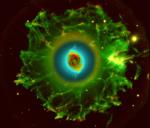 Halo of the Cat's Eye
4.09.2002
The Cat's Eye Nebula (NGC 6543) is one of the best known planetary nebulae in the sky. Its haunting symmetries are seen in the very central region of this stunning false-color picture, processed...
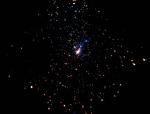 X Ray Stars in the Orion Nebula
19.05.2005
When our middle-aged Sun was just a few million years old it was thousands of times brighter in x-rays. In fact, it was likely similar to some of the stars found in this false-color x-ray composite of the Orion Nebula region from the Chandra Observatory.
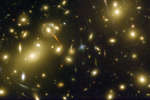 Abell 2218: A Galaxy Cluster Lens
10.02.2008
Gravity can bend light, allowing huge clusters of galaxies to act as telescopes. Almost all of the bright objects in this Hubble Space Telescope image are galaxies in the cluster known as Abell 2218.
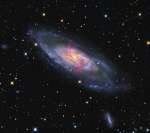 Messier 106
19.03.2011
Close to the Great Bear (Ursa Major) and surrounded by the stars of the Hunting Dogs (Canes Venatici), this celestial wonder was discovered in 1781 by the metric French astronomer Pierre Mechain. Later, it was added to the catalog of his friend and colleague Charles Messier as M106.
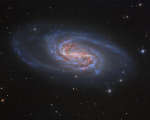 NGC 2903: A Missing Jewel in Leo
10.04.2015
Barred spiral galaxy NGC 2903 is only some 20 million light-years distant. Popular among amateur astronomers, it shines in the northern spring constellation Leo, near the top of the lion's head. That part of the constellation is sometimes seen as a reversed question mark or sickle.
 Peculiar Galaxies of Arp 273
5.01.2017
The spiky stars in the foreground of this sharp cosmic portrait are well within our own Milky Way Galaxy. The two eye-catching galaxies lie far beyond the Milky Way, at a distance of over 300 million light-years. Their distorted appearance is due to gravitational tides as the pair engage in close encounters.
|
January February March April May June July August |
||||||||||||||||||||||||||||||||||||||||||||||||||||||||