
|
You entered: astronomer
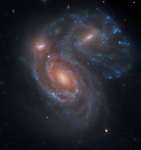 Arp 272
22.09.2011
Linking spiral arms, two large colliding galaxies are featured in this remarkable cosmic portrait constructed using image data from the Hubble Legacy Archive. Recorded in astronomer Halton Arp's Atlas of Peculiar Galaxies as Arp 272, the pair is otherwise known as NGC 6050 near center, and IC 1179 at upper right.
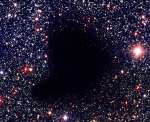 Molecular Cloud Barnard 68
29.01.2012
Where did all the stars go? What used to be considered a hole in the sky is now known to astronomers as a dark molecular cloud. Here, a high concentration of dust and molecular gas absorb practically all the visible light emitted from background stars.
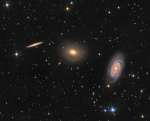 Three Galaxies in Draco
16.10.2013
This intriguing trio of galaxies is sometimes called the Draco Group, located in the northern constellation of (you guessed it) Draco. From left to right are edge-on spiral NGC 5981, elliptical galaxy NGC 5982...
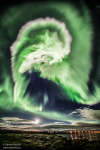 A Spiral Aurora over Iceland
15.09.2015
What's happened to the sky? Aurora! Captured late last month, this aurora was noted by Icelanders for its great brightness and quick development. The aurora resulted from a solar storm, with high energy particles bursting out from the Sun and through a crack in Earth's protective magnetosphere a few days later.
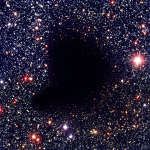 Dark Molecular Cloud Barnard 68
8.10.2017
Where did all the stars go? What used to be considered a hole in the sky is now known to astronomers as a dark molecular cloud. Here, a high concentration of dust and molecular gas absorb practically all the visible light emitted from background stars.
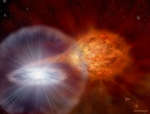 Explosions from White Dwarf Star RS Oph
22.08.2021
Spectacular explosions keep occurring in the binary star system named RS Ophiuchi. Every 20 years or so, the red giant star dumps enough hydrogen gas onto its companion white dwarf star to set off a brilliant thermonuclear explosion on the white dwarf's surface.
 NGC 253: Dusty Island Universe
15.02.2024
Shiny NGC 253 is one of the brightest spiral galaxies visible, and also one of the dustiest. Some call it the Silver Coin Galaxy for its appearance in small telescopes, or just the Sculptor Galaxy for its location within the boundaries of the southern constellation Sculptor.
 Galaxies in the Furnace
4.12.2025
An example of violence on a cosmic scale, enormous elliptical galaxy NGC 1316 lies about 75 million light-years away toward Fornax, the southern constellation of the Furnace. Investigating the startling sight, astronomers suspect...
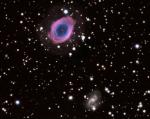 A Tale of Two Nebulae
16.05.2003
This colorful telescopic view towards the northern constellation Lyra reveals dim outer regions around M57, popularly known as the Ring Nebula. While modern astronomers still refer to M57 as a planetary nebula, at one light-year across M57 is not a planet but the gaseous shroud of a dying sun-like star.
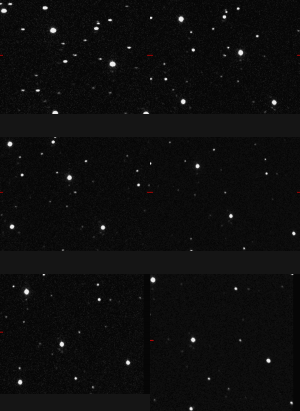 Asteroid 2004 FH Whizzes By
22.03.2004
Last week, a small asteroid approached unusually close to the Earth. Asteroid 2004 FH posed no danger, but became bright enough to see with binoculars. Passing only 7 Earth radii away, this asteroid pass was the closest yet that was previously predicted, although it was discovered only two days before.
|
January February March April May June July August |
||||||||||||||||||||||||||||||||||||||||||||||||||||||||