
|
You entered: astronomer
 APOD: 2023 October 3 Б MyCn 18: The Engraved Hourglass Planetary Nebula
2.10.2023
Do you see the hourglass shape -- or does it see you? If you can picture it, the rings of MyCn 18 trace the outline of an hourglass -- although one with an unusual eye in its center. Either way, the sands of time are running out for the central star of this hourglass-shaped planetary nebula.
 APOD: 2026 March 10 Б Sky Glows over Paranal Observatory
9.03.2026
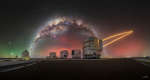
Are lasers from giant telescopes being used to defend the Earth? No. Lasers shot from telescopes are now commonly used to help increase the accuracy of astronomical observations. In some directions, Earth atmosphere-induced fluctuations in starlight can indicate how the air mass over a telescope is changing, but in other directions, no bright star exists.
 Jupiter s Great X Ray Spot
28.02.2002
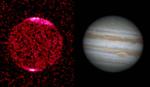
The Solar System's largest planet, gas giant Jupiter, is famous for its swirling Great Red Spot. In the right hand panel above, the familiar giant planet with storm system and cloud bands is shown in an optical image from the passing Cassini spacecraft.
 G21.5-0.9: A Supernova s Cosmic Shell
21.04.2005
The picture is lovely, but this pretty cosmic shell was produced by almost unbelievable violence - created when a star with nearly 20 times the mass of the sun blasted away its outer layers in a spectacular supernova explosion.
 Astronomy From An F-18
27.01.2000
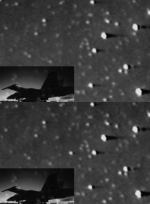
In an era of blossoming ground and space-based observatories, astronomers are also pushing the envelope with airborne instrumentation - successfully capturing an asteroid occultation from a high performance jet aircraft. This blinking animation represents...
 Small Worlds Ceres and Vesta
22.06.2007
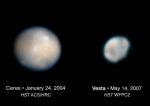
Ceres and Vesta are, respectively, only around 950 kilometers and 530 kilometers in diameter - about the size of Texas and Arizona. But they are two of the largest of over 100,000 minor bodies orbiting in the main asteroid belt between Mars and Jupiter.
 Planetary Nebula Mz3: The Ant Nebula
25.04.2015
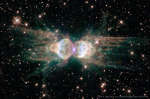
Why isn't this ant a big sphere? Planetary nebula Mz3 is being cast off by a star similar to our Sun that is, surely, round. Why then would the gas that is streaming away create an ant-shaped nebula that is distinctly not round?
 The Lunar X
9.12.2016
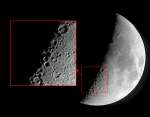
The striking X appearing in this lunarscape is easily visible in binoculars or a small telescope. Yet, not too many have seen it. The catch is this lunar X is fleeting, only apparent in the hours before the Moon's first quarter phase.
 NGC 3621: Far Beyond the Local Group
23.02.2017
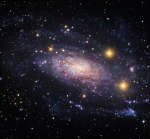
Far beyond the local group of galaxies lies NGC 3621, some 22 million light-years away. Found in the multi-headed southern constellation Hydra, the winding spiral arms of this gorgeous island universe are loaded with luminous blue star clusters, pinkish starforming regions, and dark dust lanes.
 M13: The Great Globular Cluster in Hercules
18.03.2020
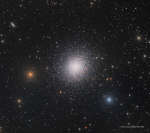
In 1716, English astronomer Edmond Halley noted, "This is but a little Patch, but it shews itself to the naked Eye, when the Sky is serene and the Moon absent." Of course...
|
January February March April May June July August |
||||||||||||||||||||||||||||||||||||||||||||||||||||||||