
|
You entered: astronomer
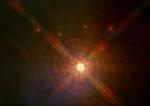 Young Suns
19.02.2000
The star cataloged as NGC2264 IRS is normally hidden from the inquiring gaze of optical telescopes. It resides in the midst of the obscuring gas and dust of a nearby star forming region popularly known as the Cone Nebula.
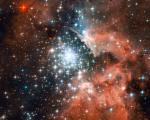 Starburst Cluster in NGC 3603
5.10.2007
A mere 20,000 light-years from the Sun lies NGC 3603, a resident of the nearby Carina spiral arm of our Milky Way Galaxy. NGC 3603 is well known to astronomers as one of the Milky Way's largest star-forming regions.
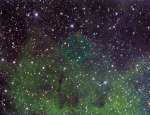 A Bubble in Cygnus
13.11.2008
Adrift in the rich star fields of the constellation Cygnus, this lovely, symmetric bubble nebula was only recently recognized and may not yet appear in astronomical catalogs. In fact, amateur astronomer Dave Jurasevich identified...
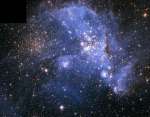 NGC 346 in the Small Magellanic Cloud
17.10.2010
How and why are all these stars forming? Found among the Small Magellanic Cloud's (SMC's) clusters and nebulae NGC 346 is a star forming region about 200 light-years across, pictured above by the Hubble Space Telescope.
 Saturn Storm Panoramas
8.07.2011
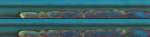
These tantalizing panoramas follow a remarkable giant storm encircling the northern hemisphere of ringed planet Saturn. Still active, the roiling storm clouds were captured in near-infrared images recorded by the Cassini spacecraft on February 26 and stitched into the high resolution, false-color mosaics.
 Wisps Surrounding the Horsehead Nebula
9.09.2012
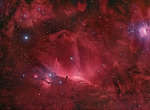
The famous Horsehead Nebula in Orion is not alone. A deep exposure shows that the dark familiar shaped indentation, visible just below center, is part of a vast complex of absorbing dust and glowing gas.
 Waterton Lake Eclipse
17.04.2014
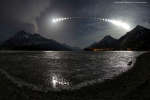
Recorded on April 15th, this total lunar eclipse sequence looks south down icy Waterton Lake from the Waterton Lakes National Park in Alberta, Canada, planet Earth. The most distant horizon includes peaks in Glacier National Park, USA.
 Reflections on the 1970s
18.12.2014
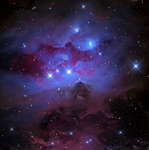
The 1970s are sometimes ignored by astronomers, like this beautiful grouping of reflection nebulae in Orion - NGC 1977, NGC 1975, and NGC 1973 - usually overlooked in favor of the substantial glow from the nearby stellar nursery better known as the Orion Nebula.
 APOD is 20 Years Old Today
16.06.2015
Welcome to the vicennial year of the Astronomy Picture of the Day! Perhaps a source of web consistency for some, APOD is still here. As during each of the 20 years of selecting images...
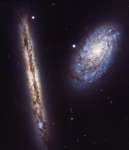 NGC 4302 and NGC 4298
21.04.2017
Seen edge-on, spiral galaxy NGC 4302 (left) lies about 55 million light-years away in the well-groomed constellation Coma Berenices. A member of the large Virgo Galaxy Cluster, it spans some 87,000 light-years, a little smaller than our own Milky Way.
|
January February March April May June July August |
||||||||||||||||||||||||||||||||||||||||||||||||||||||||