
|
You entered: astronomer
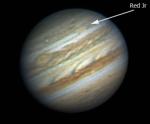 Red Spot Jr
18.03.2006
Jupiter's Great Red Spot, is a swirling storm seen for over 300 years, since the begining of telescopic observations of the Solar System's ruling gas giant. But over the last month it has been joined by Red Spot Jr.
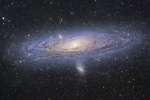 Andromeda Island Universe
24.01.2008
The most distant object easily visible to the unaided eye is M31, the great Andromeda Galaxy some two and a half million light-years away. But without a telescope, even this immense spiral galaxy - spanning over 200,000 light years - appears as a faint, nebulous cloud in the constellation Andromeda.
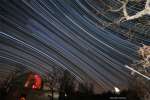 Haute Provence Star Trails
14.03.2009
Fix your camera to a tripod and you can record the graceful trails traced by the stars as planet Earth rotates on its axis. For example, this dramatic 5 hour long exposure was made on February 24 from Haute-Provence Observatory (OHP) in southeastern France.
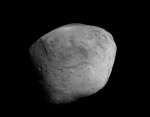 Comet Tempel 1 from Stardust NeXT Spacecraft
16.02.2011
No comet has ever been visited twice before. Therefore, the unprecedented pass of the Stardust-NeXT spacecraft near Comet Tempel 1 earlier this week gave humanity a unique opportunity to see how the nucleus of a comet changes over time.
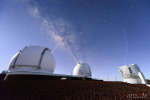 Four Lasers over Mauna Kea
23.06.2014
Are lasers from giant telescopes being used to attack the Galactic center? No. Lasers shot from telescopes are now commonly used to help increase the accuracy of astronomical observations. In some sky locations, Earth...
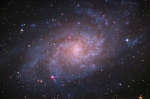 M33: Triangulum Galaxy
27.09.2018
The small, northern constellation Triangulum harbors this magnificent face-on spiral galaxy, M33. Its popular names include the Pinwheel Galaxy or just the Triangulum Galaxy. M33 is over 50,000 light-years in diameter, third largest in the Local Group of galaxies after the Andromeda Galaxy (M31), and our own Milky Way.
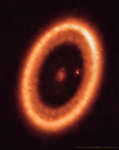 PDS 70: Disk, Planets, and Moons
24.08.2021
It's not the big disk that's attracting the most attention. Although the big planet-forming disk around the star PDS 70 is clearly imaged and itself quite interesting. It's also not the planet on the right, just inside the big disk, thatБs being talked about the most.
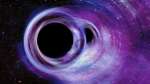 APOD: 2026 April Б Caught in the Web
3.04.2026
How can we see what is invisible? Black holes are not easy to see in the dark cosmic night, but astronomers can find them by analyzing their gravitational effects on matter, light and spacetime.
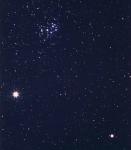 Jupiter, Saturn and Messier 45
22.03.2001
Brilliant Venus falls out of the evening sky as March ends, but Jupiter and Saturn remain well up above the western horizon. Jupiter blazes forth above and to the left of a slightly fainter Saturn in this telephoto picture taken on January 19th.
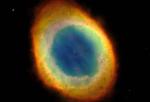 M57: The Ring Nebula
29.07.2001
Except for the rings of Saturn, the Ring Nebula (M57) is probably the most famous celestial band. This planetary nebula's simple, graceful appearance is thought to be due to perspective -- our view from planet Earth looking straight into what is actually a barrel-shaped cloud of gas shrugged off by a dying central star.
|
January February March April May June July August |
||||||||||||||||||||||||||||||||||||||||||||||||||||||||