
|
You entered: astronomer
 M33: Triangulum Galaxy
16.09.2016
The small, northern constellation Triangulum harbors this magnificent face-on spiral galaxy, M33. Its popular names include the Pinwheel Galaxy or just the Triangulum Galaxy. M33 is over 50,000 light-years in diameter, third largest in the Local Group of galaxies after the Andromeda Galaxy (M31), and our own Milky Way.
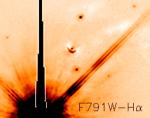 Diffraction Spikes: When Stars Look Like Crosses
15.04.2001
Unusual appendages around bright stars are commonplace, but never seem to be mentioned. What are they? First, a telescope brings starlight falling over a large area to a small area. To get at this...
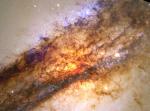 The Center of Centaurus A
21.04.2002
A fantastic jumble of young blue star clusters, gigantic glowing gas clouds, and imposing dark dust lanes surrounds the central region of the active galaxy Centaurus A. This mosaic of Hubble Space Telescope images taken in blue, green, and red light has been processed to present a natural color picture of this cosmic maelstrom.
 GL 105C: The Coolest Star?
20.09.1995
Is the dim star to the upper right of this false-color picture the coolest possible normal star? From this recent picture by the Hubble Space Telescope, astronomers have estimated its mass is just high enough for it to fuse hydrogen into helium in its core.
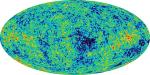 WMAP Resolves the Universe
11.02.2003
Analyses of a new high-resolution map of microwave light emitted only 380,000 years after the Big Bang appear to define our universe more precisely than ever before. The eagerly awaited results from the orbiting Wilkinson Microwave Anisotropy Probe resolve several long-standing disagreements in cosmology rooted in less precise data.
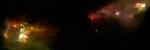 HH1/HH2: Star Jets
19.06.1997
A cloud of interstellar gas and dust collapses and a star is born. At its core temperatures rise, a nuclear furnace ignites, and a rotating dusty disk forms surrounding the newborn star. According...
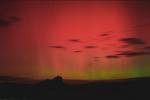 Aurora in Colorado Skies
29.10.2003
Vivid auroral displays were triggered by a cloud of high energy particles from the Sun that collided with planet Earth's magnetosphere yesterday, October 29, at about 06:30 Universal Time. The collision...
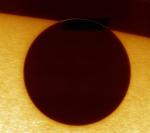 Venus at the Edge
10.06.2004
With Venus in transit at the Sun's edge on June 8th, astronomers captured this tantalizing close-up view of the bright solar surface and partially silhouetted disk. Enhanced in the sharp picture, a delicate arc of sunlight refracted through the Venusian atmosphere is also visible outlining the planet's edge against the blackness of space.
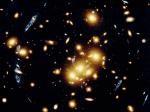 Giant Cluster Bends, Breaks Images
7.08.2004
What are those strange blue objects? Many are images of a single, unusual, beaded, blue, ring-like galaxy which just happens to line-up behind a giant cluster of galaxies. Cluster galaxies here appear yellow and -- together with the cluster's dark matter -- act as a gravitational lens.
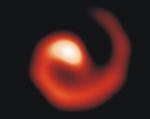 WR 104: Pinwheel Star
9.04.1999
Like a cosmic lawn sprinkler, dust streaming from a rotating star system creates a pinwheel pattern in this false color infrared image. Astronomers discovered the surprising star dust scenario using a sophisticated interferometer and the 10 meter Keck I telescope to observe the bright Wolf-Rayet star WR 104.
|
January February March April May June July August |
||||||||||||||||||||||||||||||||||||||||||||||||||||||||