
|
You entered: stars
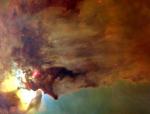 In the Center of the Lagoon Nebula
4.03.2003
The center of the Lagoon Nebula is busy with the awesome spectacle of star formation. Visible in the lower left, at least two long funnel-shaped clouds, each roughly half a light-year long, have been formed by extreme stellar winds and intense energetic starlight. The tremendously bright nearby star, Hershel 36, lights the area.
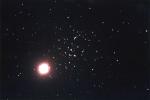 Jupiter in the Hive
3.04.2003
If you can find planet Jupiter in tonight's sky, then you can also find M44, popularly known as the Beehive star cluster. In fact, with a pair of binoculars most casual skygazers should find it easy to zero in on this celestial scene.
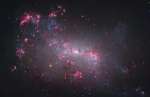 NGC 4449: Close up of a Small Galaxy
25.02.2011
Grand spiral galaxies often seem to get all the glory. Their young, blue star clusters and pink star forming regions along sweeping spiral arms are guaranteed to attract attention. But small irregular galaxies form stars too, like NGC 4449, about 12 million light-years distant.
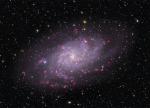 M33: Spiral Galaxy in Triangulum
14.09.2006
The small, northern constellation Triangulum harbors this magnificent face-on spiral galaxy, M33. Its popular names include the Pinwheel Galaxy or just the Triangulum Galaxy. M33 is over 50,000 light-years in diameter, third largest in the Local Group of galaxies after the Andromeda Galaxy (M31), and our own Milky Way.
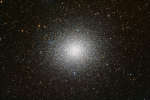 Omega Centauri: The Brightest Globular Cluster
1.05.2013
This huge ball of stars predates our Sun. Long before humankind evolved, before dinosaurs roamed, and even before our Earth existed, ancient globs of stars condensed and orbited a young Milky Way Galaxy. Of the 200 or so globular clusters that survive today, Omega Centauri is the largest, containing over ten million stars.
 APOD: 2025 November 24 Б Apep: Unusual Dust Shells from Webb
24.11.2025
What created this unusual space sculpture? Stars. This unusual system of swirls and shells, known as Apep, was observed in unprecedentedбdetail by NASAБs James Webb Space Telescope in infrared light in 2024. Observations indicate...
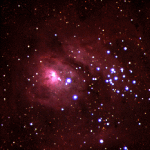 Open Cluster M8 in the Lagoon
27.01.1996
The large majestic Lagoon Nebula is home for many young stars and hot gas. The Lagoon Nebulae is so large and bright it can be seen without a telescope. Formed only several million years...
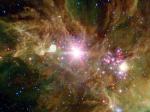 The Snowflake Cluster versus the Cone Nebula
9.05.2007
Strange shapes and textures can be found in the neighborhood of the Cone Nebula. These patterns result from the tumultuous unrest that accompanies the formation of the open cluster of stars known as NGC 2264, the Snowflake cluster.
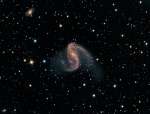 NGC 2442: Galaxy in Volans
28.02.2009
Distorted galaxy NGC 2442 can be found in the southern constellation of the flying fish, (Piscis) Volans. Located about 50 million light-years away, the galaxy's two spiral arms extending from a pronounced central bar give it a hook-shaped appearance.
 NGC 1360: The Robin's Egg Nebula
5.08.2023
This pretty nebula lies some 1,500 light-years away, its shape and color in this telescopic view reminiscent of a robin's egg. The cosmic cloud spans about 3 light-years, nestled securely within the boundaries of the southern constellation Fornax. Recognized as a planetary nebula, egg-shaped NGC 1360 doesn't represent a beginning though.
|
January February March April May June July August September October |
|||||||||||||||||||||||||||||||||||||||||||||||||