
|
You entered: stars
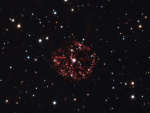 GK Per: Nova of 1901
5.11.2011
Early in the 20th century, GK Persei briefly became one of the brightest stars in planet Earth's sky, an event known as Nova Persei 1901. Documented in this modern day composite of two images from 2003 and 2011 the ejecta from the explosion, popularly called the Firework Nebula, continues to expand into space.
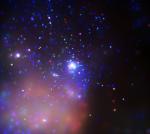 X Ray Portrait of Trumpler 14
2.09.2005
A wonder of planet Earth's southern sky, star cluster Trumpler 14 lies about nine thousand light-years away in the Carina complex -- a rich star forming region at the edge of a giant molecular cloud.
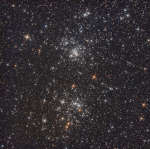 The Double Cluster in Perseus
8.10.2021
This pretty starfield spans about three full moons (1.5 degrees) across the heroic northern constellation of Perseus. It holds the famous pair of open star clusters, h and Chi Persei. Also cataloged...
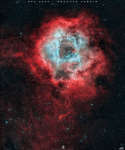 Roses are Red
14.02.2026
Roses are red, nebulas are too, and this Valentine's gift is a stunning view! Pictured is a loving look at the Rosette Nebula (NGC 2237): a cosmic bloom of bright young stars sitting atop a stem of glowing hot gas.
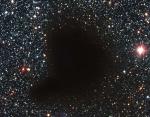 Molecular Cloud Barnard 68
23.09.2001
Where did all the stars go? What used to be considered a hole in the sky is now known to astronomers as a dark molecular cloud. Here, a high concentration of dust and molecular gas absorb practically all the visible light emitted from background stars.
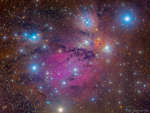 NGC 2170: Angel Nebula Still Life
26.08.2019
Is this a painting or a photograph? In this classic celestial still life composed with a cosmic brush, dusty nebula NGC 2170, also known as the Angel Nebula, shines near the image center. Reflecting...
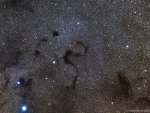 Snake in the Dark
20.02.2009
Dark nebulae snake across a gorgeous expanse of stars in this telescopic view toward the pronounceable constellation Ophiuchus and the center of our Milky Way Galaxy. In fact, the twisting central shape seen here is well known as the Snake Nebula.
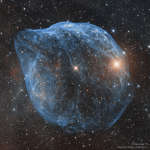 Sharpless 308: The Dolphin Nebula
2.03.2020
Blown by fast winds from a hot, massive star, this cosmic bubble is much larger than the dolphin it appears to be. Cataloged as Sharpless 2-308 it lies some 5,200 light-years away toward the constellation of the Big Dog (Canis Major) and covers slightly more of the sky than a Full Moon.
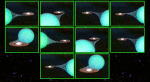 Black Hole Signature From Advective Disks
15.01.1997
What does a black hole look like? If alone, a black hole would indeed appear quite black, but many black hole candidates are part of binary star systems. So how does a black hole binary system look different from a neutron star binary system? The above drawings indicate it is difficult to tell!
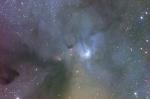 IC 4603: Reflection Nebula in Ophiuchius
21.07.2003
Why does this starfield photograph resemble an impressionistic painting? The effect is created not by digital trickery but by large amounts of interstellar dust. Dust, minute globs rich in carbon and similar in size to cigarette smoke, frequently starts in the outer atmospheres of large, cool, young stars.
|
January February March April May June July August September October |
|||||||||||||||||||||||||||||||||||||||||||||||||