
|
You entered: satellite
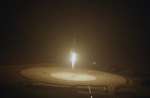 Falcon 9 First Stage Landing
28.12.2015
The booster has landed. Spaceflight took a step toward the less expensive last week when the first stage of a Falcon 9 rocket set down on a landing pad not far from its Florida launch.
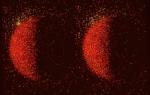 X Ray Moon and X Ray Star
9.09.2000
An x-ray star winks out behind the Moon in these before (left) and after views of a lunar occultation of the galactic x-ray source designated GX5-1. The false color images were made using data from the ROSAT (ROentgen SATellite), orbiting observatory.
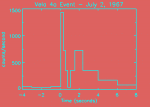 Gamma-Ray Burst: A Milestone Explosion
2.07.1997
Gamma-Ray Bursts (GRBs) were discovered by accident. In fact, GRBs always seem to be where scientists least expect them. Thirty years ago today, satellites first recorded a GRB. The burst data plotted in this histogram show that the count rate of the gamma-ray instrument abruptly jumped indicating a sudden flash of gamma-rays.
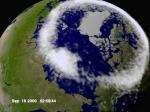 A Proton Aurora
17.12.2003
What are auroras made out of? Most auroras are caused by the solar wind exciting electrons that are funneled down the Earth's magnetic field. These electrons strike air molecules, liberating other electrons that glow when re-acquired.
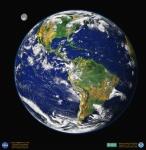 Big Blue Marble Earth
26.04.2003
This reconstructed digital portrait of our planet is reminiscent of the Apollo-era pictures of the "big blue marble" Earth from space. To create it, researchers at Goddard Space Flight Center's Laboratory for Atmospheres...
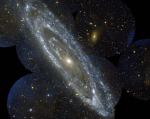 The Andromeda Galaxy from GALEX
22.12.2003
Why does the Andromeda Galaxy have a giant ring? Viewed in ultraviolet light, the closet major galaxy to our Milky Way Galaxy looks more like a ring galaxy than a spiral. The ring...
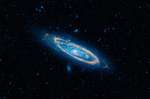 WISE Infrared Andromeda
19.02.2010
This sharp, wide-field view features infrared light from the spiral Andromeda Galaxy (M31). Dust heated by Andromeda's young stars is shown in yellow and red, while its older population of stars appears as a bluish haze. The false-color skyscape is a mosaic of images from NASA's new Wide-field Infrared Survey Explorer (WISE) satellite.
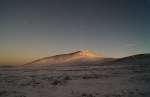 The Snows of Paranal
11.08.2011
Recorded last week, this dawn portrait of snowy mountain and starry sky captures a very rare scenario. The view does feature a pristine sky above the 2,600 meter high mountain Cerro Paranal, but clear skies over Paranal are not at all unusual.
 Night Shining Clouds
5.07.2007
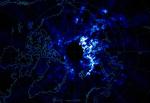
Alluring noctilucent or night-shining clouds lie near the edge of space, some 80 kilometers above Earth's surface. Of course, when viewed from space the clouds are more properly called polar mesospheric clouds (PMCs) -- seen here for the first time in image data from the Aeronomy of Ice in the Mesosphere (AIM) satellite.
 The Large Cloud of Magellan
28.05.2013
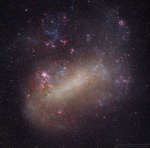
The 16th century Portuguese navigator Ferdinand Magellan and his crew had plenty of time to study the southern sky during the first circumnavigation of planet Earth. As a result, two fuzzy cloud-like objects easily...
|
January February March April May June July August |
||||||||||||||||||||||||||||||||||||||||||||||||||||||||