
|
You entered: Moon
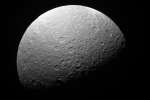 Ancient Craters of Southern Rhea
13.05.2008
Saturn's ragged moon Rhea has one of the oldest surfaces known. Estimated as changing little in the past billion years, Rhea shows craters so old they no longer appear round their edges have become compromised by more recent cratering.
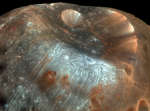 Stickney Crater
5.05.2018
Stickney Crater, the largest crater on the martian moon Phobos, is named for Chloe Angeline Stickney Hall, mathematician and wife of astronomer Asaph Hall. Asaph Hall discovered both the Red Planet's moons in 1877.
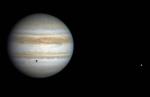 Cassini Spacecraft Approaches Jupiter
11.10.2000
A new spacecraft has entered the outer Solar System: Cassini. Launched in 1997 and bound for Saturn in 2004, Cassini sent back the above image last week while approaching the giant planet Jupiter. Cassini joins the Galileo spacecraft currently in orbit around Jupiter in studying the gas giant and its moons.
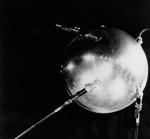 Sputnik: Traveling Companion
7.10.2000
Sputnik means "traveling companion". Despite the innocuous sounding name, the launch of the Earth's first "artificial moon", Sputnik 1, by the Soviet Union on October 4, 1957 shocked the free world, setting in motion events which resulted in the creation of NASA and the race to the Moon.
 Oceans Under Jupiter's Europa?
9.04.1997
Is there life beneath Europa? Today, new results are being announced (at about 2 pm EST) about the possibility of oceans under Jupiter's moon Europa. The existence of such oceans increases the likelihood that some sort of life exists beneath the fractured ice planes of Jupiter's smoothest satellite.
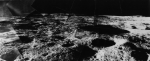 Surveyor Hops
22.11.1997
This panorama of the cratered lunar surface was constructed from images returned by the US Surveyor 6 lander. Surveyor 6 was not the first spacecraft to accomplish a soft landing on the Moon ... but it was the first to land and then lift off again!
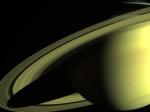 24 Million Kilometers to Saturn
31.05.2004
Next stop: Saturn. The Cassini-Huygens spacecraft is approaching Saturn and will fire its engines to break into orbit around the ringed giant on July 1. The robot spacecraft was launched in 1997 and rounded Jupiter in 2001.
 Apollo 11: Onto a New World
20.07.2009
A human first set foot on another world on July 20, 1969. This world was Earth's own Moon. In honor of today's 40th anniversary, NASA has released a digitally restored video of this milestone in human history. Pictured above is Neil Armstrong preparing to take the historic first step.
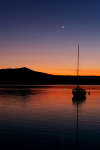 Conjunction at Sunset
29.12.2011
While Comet Lovejoy entertained early morning risers in in the southern hemisphere, a lovely conjunction of a young crescent Moon and Venus graced western skies at sunset. Captured on December 26th the conjunction, with beautiful sunset colors above and below, is seen here over Viverone Lake near Turin, Italy.
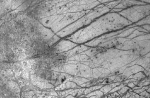 Galileo Explores Europa
14.08.1996
Details of the crazed cracks criss-crossing Europa's frozen surface are apparent in this mosaic of the Galileo spacecraft's latest images of Jupiter's ice-covered moon. Curious white stripes, also seen by Voyager, are clearly visible marking the center of the wide dark fractures.
|
January February March April May June July August September October |
|||||||||||||||||||||||||||||||||||||||||||||||||