
|
You entered: distance
 Hyades for the Holidays
24.12.2012
Recognized since antiquity and depicted on the shield of Achilles according to Homer, stars of the Hyades cluster form the head of the constellation Taurus the Bull. Their general V-shape is anchored by Aldebaran, the eye of the Bull and by far the constellation's brightest star.
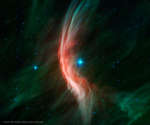 Zeta Oph: Runaway Star
8.04.2017
Like a ship plowing through cosmic seas, runaway star Zeta Ophiuchi produces the arcing interstellar bow wave or bow shock seen in this stunning infrared portrait. In the false-color view, bluish Zeta...
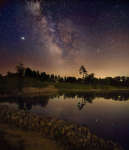 The Milky Way Over Ontario
29.07.2008
Sometimes, after your eyes adapt to the dark, a spectacular sky appears. Such was the case earlier this month over Ontario, Canada, when part of a spectacular sky also became visible in a reflection off a lake.
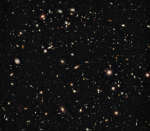 HUDF Infrared: Dawn of the Galaxies
9.12.2009
When did galaxies form? To help find out, the deepest near-infrared image of the sky ever has been taken of the same field as the optical-light Hubble Ultra Deep Field (HUDF) in 2004. The new image was taken this summer by the newly installed Wide Field Camera 3 on the refurbished Hubble Space Telescope.
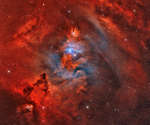 A Fox Fur, a Unicorn, and a Christmas Tree
10.04.2012
What do the following things have in common: a cone, the fur of a fox, and a Christmas tree? Answer: they all occur in the constellation of the unicorn (Monoceros). Pictured above...
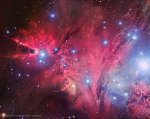 A Fox Fur, a Unicorn, and a Christmas Tree
4.01.2015
What do the following things have in common: a cone, the fur of a fox, and a Christmas tree? Answer: they all occur in the constellation of the unicorn (Monoceros). Pictured as a star...
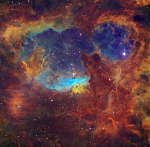 Massive Stars in NGC 6357
5.02.2016
Massive stars lie within NGC 6357, an expansive emission nebula complex some 6,500 light-years away toward the tail of the constellation Scorpius. In fact, positioned near center in this ground-based close-up...
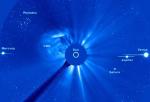 Pleiades, Planets, And Hot Plasma
24.05.2000
Bright stars of the Pleiades, four planets, and erupting solar plasma are all captured in this spectacular image from the space-based SOlar and Heliospheric Observatory (SOHO). In the foreground of the 15 degree wide field of view, a bubble of hot plasma, called a Coronal Mass Ejection (CME)
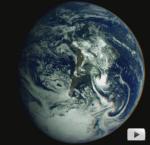 Rotating Earth from Galileo
14.05.2007
When passing Earth on your way to Jupiter, what should you look for? That question arose for the robotic Galileo spacecraft that soundlessly coasted past the Solar System's most photographed orb almost two decades ago.
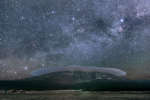 A Protected Night Sky Over Flagstaff
16.04.2008
This sky is protected. Yesterday marked the 50 year anniversary of the first lighting ordinance ever enacted, which restricted searchlight advertisements from sweeping the night skies above Flagstaff, Arizona, USA. Flagstaff now enjoys...
|
January February March April May June July August September October |
|||||||||||||||||||||||||||||||||||||||||||||||||