
|
You entered: distance
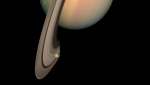 Cassini Approaches Saturn
19.04.2020
What would it look like to approach Saturn in a spaceship? One doesn't have to just imagine -- the Cassini spacecraft did just this in 2004, recording thousands of images along the way, and hundreds of thousands more since entering orbit.
 A Cosmic Zoo in Cepheus
17.08.2023
Sprawling emission nebulae IC 1396 and Sh2-129 mix glowing interstellar gas and dark dust clouds in this nearly 12 degree wide field of view toward the northern constellation Cepheus the King. Energized by its central star IC 1396 (left), is hundreds of light-years across and some 3,000 light-years distant.
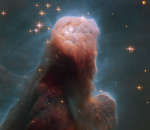 The Cone Nebula from Hubble
28.05.2014
Stars are forming in the gigantic dust pillar called the Cone Nebula. Cones, pillars, and majestic flowing shapes abound in stellar nurseries where natal clouds of gas and dust are buffeted by energetic winds from newborn stars. The Cone Nebula, a well-known example, lies within the bright galactic star-forming region NGC 2264.
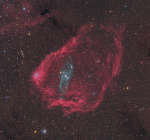 A Giant Squid in the Flying Bat
11.09.2015
Very faint but also very large on planet Earth's sky, a giant Squid Nebula cataloged as Ou4, and Sh2-129 also known as the Flying Bat Nebula, are both caught in this scene toward the royal constellation Cepheus.
 The Leo Trio
21.03.2025
This popular group leaps into the early evening sky around the March equinox and the northern hemisphere spring. Famous as the Leo Triplet, the three magnificent galaxies found in the prominent constellation Leo gather here in one astronomical field of view.
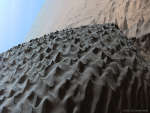 Dark Dunes on Mars
20.07.2016
How does wind affect sand on Mars? To help find out if it differs significantly from Earth, the robotic Curiosity rover on Mars was directed to investigate the dark Namib Dune in the Bagnold Dune Field in Gale Crater. Namib is the first active sand dune investigated up close outside of planet Earth.
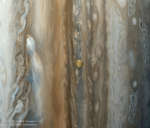 Io over Jupiter from Voyager 1
4.09.2016
Back in 1979, NASA's Voyager 1 spacecraft flew past Jupiter and its moons. The images in this mosaic, featuring the moon Io against a background of gas giant Jupiter's diffuse swirling cloud bands, were recorded by Voyager's camera from a distance of about 8.3 million kilometers.
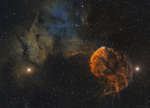 Sharpless 249 and the Jellyfish Nebula
7.03.2019
Normally faint and elusive, the Jellyfish Nebula is caught in this alluring telescopic field of view. The entire scene is a two panel mosaic constructed using narrowband image data, with emission from sulfur, hydrogen and oxygen atoms shown in red, green and blue hues.
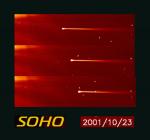 SOHO Comet 367: Sungrazer
9.11.2001
The most prolific comet discovering instrument in history rides aboard the sun-staring SOHO spacecraft, 1.5 million kilometers sunward of planet Earth. Of course, most of these SOHO comets have been sungrazers - like the one illustrated in the dramatic montage above.
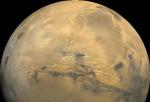 Mars: Just The Facts
27.06.1997
Mars, the freeze-dried planet, orbits 137 million miles from the Sun or at about 1.5 times the Earth-Sun distance. It has two diminutive moons, towering extinct volcanos, an immense canyon system, a thin atmosphere...
|
January February March April May June July August September October |
|||||||||||||||||||||||||||||||||||||||||||||||||