
|
You entered: distance
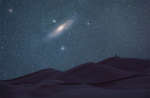 Andromeda over the Sahara Desert
11.07.2022
What is the oldest thing you can see? At 2.5 million light years distant, the answer for the unaided eye is the Andromeda galaxy, because its photons are 2.5 million years old when they reach you.
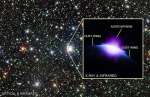 APOD: 2026 March 6 Б The Astrosphere of HD 61005
6.03.2026
Do young stars blow bubbles? The larger view shows a stellar field observed with the Cerro Tololo Inter-American Observatory in Chile, and the inset highlights HD 61005, a star like our Sun, only 120 light-years away.
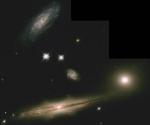 HCG 87: A Small Group of Galaxies
6.09.1999
Sometimes galaxies form groups. For example, our own Milky Way Galaxy is part of the Local Group of Galaxies. Small, compact groups, like Hickson Compact Group 87 (HCG 87) shown above, are interesting partly because they slowly self-destruct.
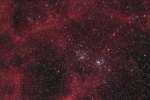 Double Cluster in Perseus
23.01.2014
This lovely starfield spans some seven full moons (about 3.5 degrees) across the heroic northern constellation of Perseus. Just right of center it holds the famous pair of open or galactic star clusters, h and Chi Perseii.
 ZTF meets ATLAS
10.02.2023
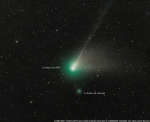
Fading as it races across planet Earth's northern skies comet C/2022 E3 (ZTF) shares this telescopic frame with comet C/2022 U2 (ATLAS). Captured on the night of February 6 from a garden observatory in Germany's Bavarian Forest, the starry field of view toward the constellation Auriga spans about 2.5 degrees.
 The Ghosts of Five Supernovas
24.09.2026
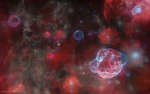
The ghosts of five supernovas haunt this extraordinary image. It was acquired at Oukaцmeden Observatory in Morocco with approximately 200 hours of observations and shows a large patch of the sky, equivalent to the area of one thousand full moons tiled together, in the constellation of Auriga (the charioteer).
 Voyager Views Titan s Haze
5.09.2002
Launched in 1977, 25 years ago today, the Voyager 1 spacecraft's historic tour of the outer Solar System took it past Saturn in late 1980. On November 12, 1980, Voyager 1 recorded this view looking across the edge of Titan, Saturn's largest moon, from a distance of about 22,000 kilometers.
 Earendel: A Star in the Early Universe
6.04.2022
Is Earendel the farthest star yet discovered? This scientific possibility started when the Hubble Space Telescope observed a huge cluster of galaxies. The gravitational lens effectбof this cluster was seen to magnify and distort a galaxy far in the background.
 APOD: 2024 February 18 Б Hoags Object: A Nearly Perfect Ring Galaxy
18.02.2024
Is this one galaxy or two? This question came to light in 1950 when astronomer Arthur Hoag chanced upon this unusual extragalactic object. On the outside is a ring dominated by bright blue stars, while near the center lies a ball of much redder stars that are likely much older.
 Small Star
5.06.1997
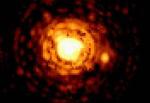
A dim double star system cataloged as Gliese 623 lies 25 light-years from Earth, in the constellation of Hercules. The individual stars of this binary system were distinguished for the first time when the Hubble Space Telescope's Faint Object Camera recorded this image in June 1994.
|
January February March April May June July August September October |
|||||||||||||||||||||||||||||||||||||||||||||||||