
|
You entered: distance
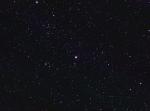 Recurrent Nova RS Ophiuci
24.02.2006
This pretty star field in the constellation Ophiucus is centered on a star not often seen - RS Ophiuci. In fact, early last week RS Oph suddenly became visible to the naked eye for the first time since 1985.
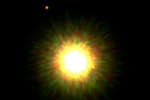 Companion of a Young, Sun-like Star Confirmed
4.07.2010
The first direct image of an extrasolar planet orbiting a star similar to our Sun has been confirmed. Located just 500 light-years away toward the constellation Scorpius, the parent star, cataloged as 1RXS J160929.1-210524, is only slightly less massive and a little cooler than the Sun.
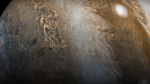 Perijove 11: Passing Jupiter
28.08.2022
Here comes Jupiter! NASA's robotic spacecraft Juno is continuing on its highly-elongated orbits around our Solar System's largest planet. The featured video is from perijove 11 in early 2018, the eleventh time Juno has passed near Jupiter since it arrived in mid-2016.
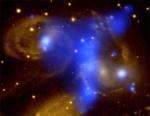 X rays from Stephan s Quintet
12.08.2003
Stephan's Quintet is a picturesque but clearly troubled grouping of galaxies about 300 million light-years away toward the high-flying constellation Pegasus. Spanning over 200,000 light-years at that distance, this composite false-color image...
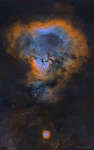 NGC 7822: Cosmic Question Mark
13.10.2021
It may look like a huge cosmic question mark, but the big question really is how does the bright gas and dark dust tell this nebula's history of star formation. At the edge...
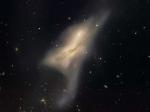 The Colliding Galaxies of NGC 520
12.09.2005
Is this one galaxy or two? The jumble of stars, gas, and dust that is NGC 520 is now thought to incorporate the remains of two separate galaxies. A combination of observations and simulations indicate the NGC 520 is actually the collision of two disk galaxies.
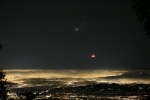 A Happy Sky Over Los Angeles
3.12.2008
Sunday, the sky seemed to smile over much of planet Earth. Visible the world over was an unusual superposition of our Moon and the planets Venus and Jupiter. Pictures taken at the right time...
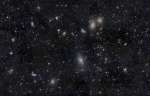 Virgo Cluster Galaxies
22.04.2011
Well over a thousand galaxies are known members of the Virgo Cluster, the closest large cluster of galaxies to our own local group. In fact, the galaxy cluster is difficult to appreciate all at once because it covers such a large area on the sky.
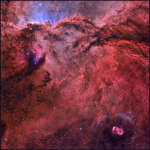 NGC 6188 and NGC 6164
28.12.2012
Fantastic shapes lurk in clouds of glowing hydrogen gas in NGC 6188, about 4,000 light-years away. The emission nebula is found near the edge of a large molecular cloud unseen at visible wavelengths, in the southern constellation Ara.
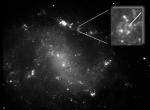 ESO 184 G82: and the Supernova Gamma Ray Burst Connection
28.02.2002
Modern astronomers keep a long list of things that go bump in the night. Near the top are supernovae - the death explosions of massive stars, and gamma-ray bursts - the most powerful explosions seen across the Universe.
|
January February March April May June July August September October |
|||||||||||||||||||||||||||||||||||||||||||||||||