
|
You entered: time
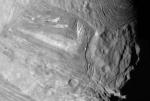 Miranda, Chevron, and Alonso
16.02.2002
Miranda is a bizarre world which surely had a tempestuous past. The innermost of the larger Uranian moons, Miranda is almost 300 miles in diameter and was discovered on today's date in 1948 by American planetary astronomer Gerard Kuiper.
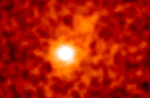 Gamma-Ray Quasars
23.10.1995
Gamma rays are more than 10,000 times more energetic than visible light. If you could "see" gamma rays, the night sky would seem very different indeed. The bright object in the center of the false color gamma-ray image above is quasar 3C279, a nondescript, faint, starlike object in the visible sky.
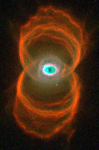 MyCn18: An Hourglass Nebula
18.01.1996
The sands of time are running out for the central star of this hourglass-shaped planetary nebula. With its nuclear fuel exhausted, this brief, spectacular, closing phase of a Sun-like star's life occurs as its outer layers are ejected - its core becoming a cooling, fading White Dwarf.
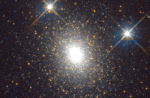 A Giant Globular Cluster in M31
26.04.1996
G1, pictured above, is the brightest known globular cluster in the whole Local Group of galaxies. Also called Mayall II, it orbits the center of the largest nearby galaxy: M31. G1 contains over 300,000 stars and is almost as old as the entire universe.
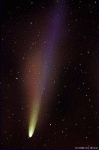 The Tails of Comet Hyakutake
2.05.1996
What makes comet tails so colorful? This photograph of Comet Hyakutake was taken the night of April 18th and highlights different components of the tail. The gold and red tail features are dust, made predominately of little bits of rock and carbon. The dust tail shines by reflecting sunlight.
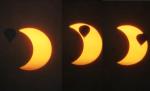 Sun, Moon, Hot Air Balloon
6.06.2003
Anticipating the celestial shadow play of a solar eclipse, sky gazers across Germany watched the Sun rise on May 31. In Bonn, astrophotographer Thilo Kranz had set up his small refractor telescope and camera on the Kennedy Bridge across the Rhein river to get a good view to the northeast.
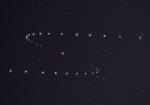 S is for Venus
7.01.2005
Planet Venus traced out this S shape in Earth's sky during 2004. Following the second planet from the Sun in a series of 29 images recorded from April 3rd through August...
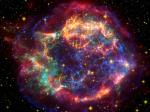 Cassiopeia A Light Echoes in Infrared
15.06.2005
Why is the image of Cassiopeia A changing? Two images of the nearby supernova remnant taken a year apart in infrared light appear to show outward motions at tremendous speeds. This was unexpected since the supernova that created the picturesque nebula was seen 325 years ago. The reason is likely light echoes.
 Astronomer s Moon
24.08.2007
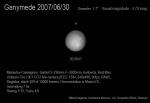
Jupiter is an astronomer's planet -- its large size and contrasting global cloud belts and zones allow detailed studies with a range of earthbound telescopes. On the other hand, most telescopic views of Jupiter's moons usually show only featureless, tantalizing points of light hovering near the ruling gas giant.
 NGC 7331 and Beyond
12.07.2008
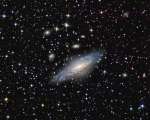
Big, beautiful spiral galaxy NGC 7331 is often touted as an analog to our own Milky Way. About 50 million light-years distant in the northern constellation Pegasus, NGC 7331 was recognized early on as a spiral nebula and is actually one of the brighter galaxies not included in Charles Messier's famous 18th century catalog.
|
January February March April May June July August |
||||||||||||||||||||||||||||||||||||||||||||||||||||||||