
|
You entered: time
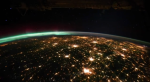 Around the World in 90 Minutes
21.11.2011
What is it like to circle the Earth? Every 90 minutes, astronauts aboard the International Space Station experience just that. Recently, crew members took a series of light-sensitive videos looking down at night that have been digitally fused to produce the above time-lapse video.
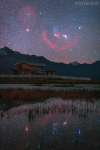 Orion Over and Under Tibet
5.10.2015
This night was so serene you could see Orion rise downwards. The unusual spectacle was captured in this single-exposure image, featuring a deep sky around the famous constellation of Orion that appeared both above -- and reflected in -- a peaceful lake in the Gyirong Valley of Tibet, China.
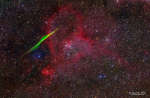 Spiral Meteor through the Heart Nebula
5.09.2016
What is this meteor doing? Dynamically, the unusually short and asymmetric train may indicate that the sand-sized grain at the center of the glow is momentarily spinning as it ablates, causing its path to be slightly spiral.
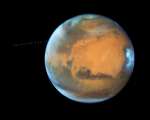 Phobos: Moon over Mars
21.07.2017
A tiny moon with a scary name, Phobos emerges from behind the Red Planet in this timelapse sequence from the Earth-orbiting Hubble Space Telescope. Over 22 minutes the 13 separate exposures were captured near the 2016 closest approach of Mars to planet Earth. Martians have to look to the west to watch Phobos rise, though.
 Sakurajima Volcano with Lightning
13.05.2018
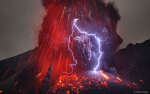
Why does a volcanic eruption sometimes create lightning? Pictured above, the Sakurajima volcano in southern Japan was caught erupting in 2013 January. Magma bubbles so hot they glowed shot away as liquid rock burst through the Earth's surface from below.
 Black Hole Safety Video
1.10.2019
If you were a small one-eyed monster, would you want to visit a black hole? Well the one in this video does -- but should it? No, actually, but since our little friend is insistent on going, the video informs it what black holes really are, and how to be as safe as possible when visiting.
 A Double Lunar Analemma over Turkey
10.10.2022
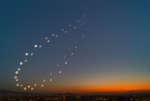
An analemma is that figure-8 curve you get when you mark the position of the Sun at the same time each day for one year. But the trick to imaging an analemma of the Moon is to wait bit longer.
 The Gum Nebula Supernova Remnant
29.11.2022
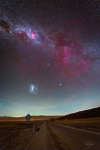
Because the Gum Nebula is the closest supernova remnant, it is actually hard to see. Spanning 40 degrees across the sky, the nebula appears so large and faint that it is easily lost in the din of a bright and complex background.
 The High Energy Crab Nebula
9.09.1996
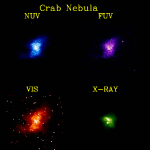
This is the mess that is left when a star explodes. The Crab Nebula is so energetic that it glows in every kind of light known. Shown above are images of the Crab Nebula from visible light to the X-ray band.
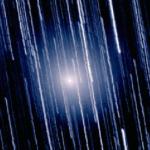 Tempel-Tuttle: The Leonid Comet
30.01.1998
Star trails streak this composite time exposure of Comet Tempel-Tuttle recorded by T. Puckett on January 26. Presently passing through the inner solar system on its 33 year orbit around the Sun, Tempel-Tuttle has brightened unexpectedly, but binoculars or small telescopes are still required to visually observe it.
|
January February March April May June July August |
||||||||||||||||||||||||||||||||||||||||||||||||||||||||